
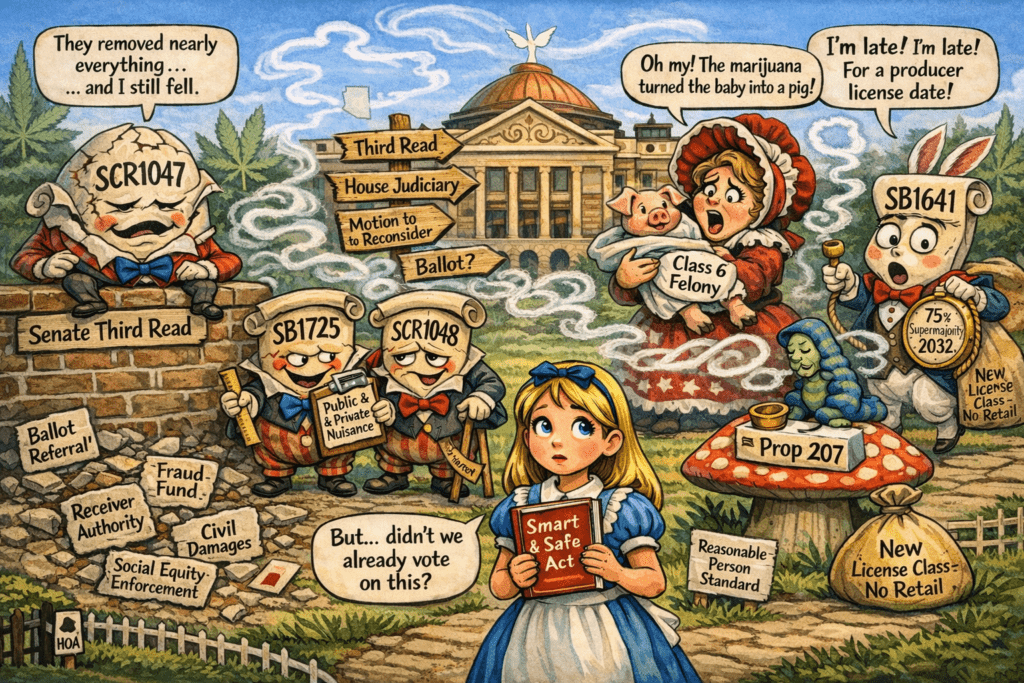
It has been a high‑energy week at the state capital, and momentum keeps building. Lawmakers now send two measures to the House, one measure falls in Senate Third Read, and another stays alive thanks to a motion to reconsider. We also add SB1476 to this week’s update lineup.
Welcome to the Update: SB1476
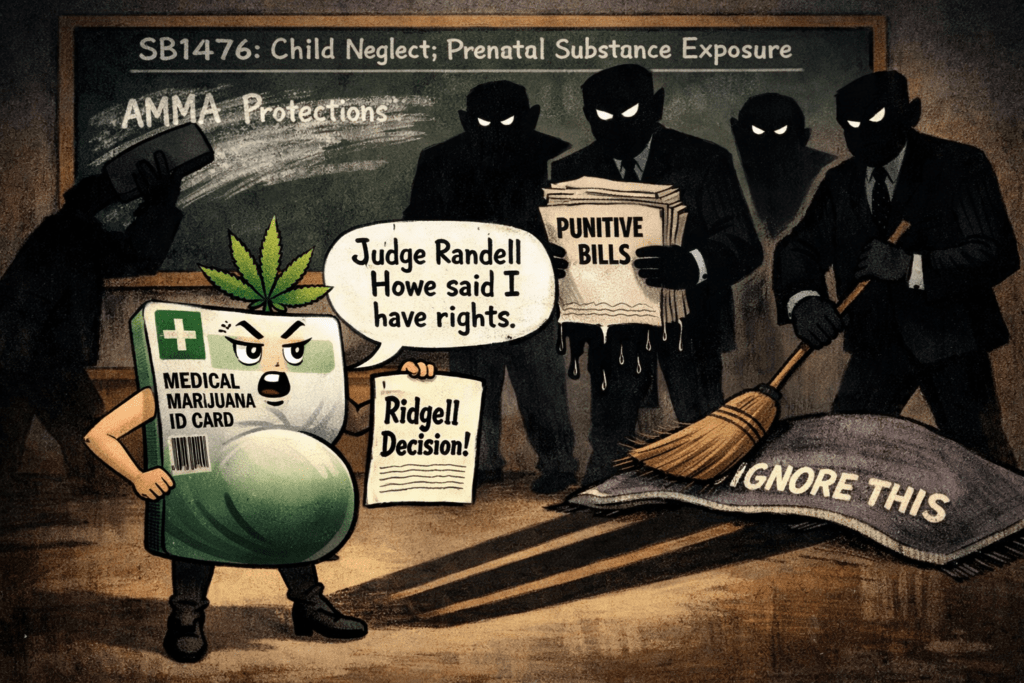
Let’s kick things off by welcoming SB1476 to the update. Lawmakers introduced this measure to create a new pregnancy‑related child neglect felony, placing mental health and substance use during pregnancy directly into Arizona’s criminal code.
SB1476 creates a class 6 felony when someone with custody harms a newborn in a way that meets the state’s definition of neglect. The bill applies when a health professional determines that a baby experienced exposure to a dangerous or narcotic drug before birth. It also applies when a doctor diagnoses a baby under one year old with fetal alcohol syndrome or related effects.
The proposal does not reference the Arizona Medical Marijuana Act, which protects registered patients from criminal penalties for legal use. In Ridgell v. Department of Child Safety, the Arizona Court of Appeals ruled that the state must treat medical marijuana patients the same as patients who use other legal prescription medications. The court made clear that officials cannot classify lawful cannabis use during pregnancy as child neglect.
SB1476 cleared the Senate and now heads to the House Judiciary Committee, where lawmakers will take the next look.
The “Twins” Split: SB1725 Moves, SCR1048 Stays Alive
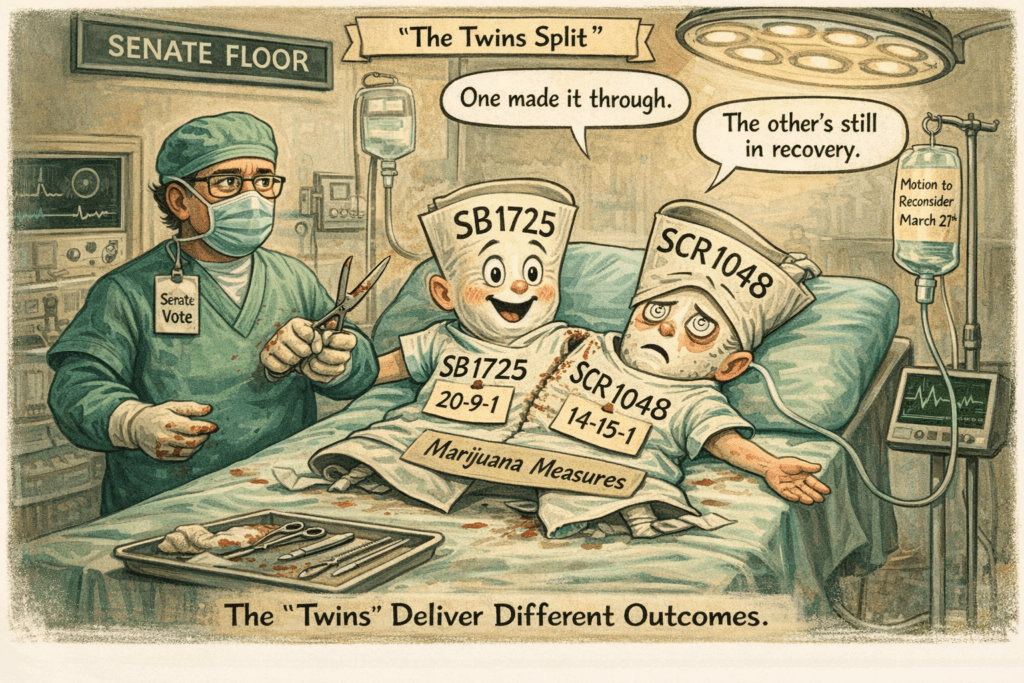
Lawmakers tackled two related marijuana measures this week, and the so‑called “twins” delivered very different outcomes.
On Monday, March 9, the Senate brought SB1725 and SCR1048 to Third Read. SB1725, which labels marijuana smoke as a public and private nuisance, passed with a 20‑9‑1 vote and now advances to the House. SCR1048, the ballot referral version, fell short in a 14‑15‑1 vote.
Sen. J.D. Mesnard later filed a motion to reconsider SCR1048, giving the proposal another path forward. Under Senate rules, lawmakers now have three legislative days to bring it back for another vote. That move keeps the measure in play.
During debate, Sen. Analise Ortiz and Sen. Lauren Kuby spoke out against SB1725, arguing that the bill conflicts with Proposition 207, the voter‑approved Smart and Safe Act. Kuby cautioned that the policy could shape future laws in concerning ways.
Not all Democrats opposed the bill. Sen. Mitzi Epstein and Sen. Theresa Hatathlie voted yes. Epstein shared that marijuana smoke bothers her and said the bill should expand to cover all smoke, including cigarettes and cigars.
Some Republicans also broke ranks. Sen. Kevin Payne and Sen. Jake Hoffman voted no, citing concerns about government overreach and personal freedom.
Mesnard defended his proposal, explaining that he softened the language and clarified his intent. Cannabis advocates pushed back, arguing that the bill relies on vague standards such as what a “reasonable person” might smell and opens the door for neighbors or homeowners’ associations to file complaints over smoke crossing property lines. They warn that the policy could trigger lawsuits, daily fines, and tighter limits on legal at‑home use.
For now, SB1725 heads to the House, and SCR1048 remains one vote away from either revival or final defeat.
SCR1047 Revived After Motion to Reconsider in Senate
SCR1047 initially fell short in the Senate after failing on a 12‑17‑1 Third Read vote. However, at the close of Senate floor proceedings on Wednesday, March 11—one day after the resolution’s defeat—a Motion to Reconsider was entered, keeping the measure procedurally alive.
Sen. Kevin Payne sponsored the resolution, which seeks to revise key components of Arizona’s Marijuana Social Equity Ownership Program. In a last‑minute effort to build support before the vote, lawmakers stripped out major enforcement and fraud provisions, removing nearly all accountability mechanisms from the original draft.
The initial version created an Attorney General Marijuana Enforcement Fund to investigate license fraud, oversee the Social Equity Ownership Program, support reentry initiatives, and provide grants to communities disproportionately impacted by past marijuana enforcement. Lawmakers removed the fund prior to the vote.
The original language also authorized the Attorney General to appoint receivers to take control of marijuana businesses involved in fraud or predatory agreements, stabilize operations, and restore licenses to qualified social equity owners. That authority was eliminated.
The amended version further removed provisions allowing original social equity license holders to petition for license restoration or pursue private legal action tied to fraud. Lawmakers also narrowed enforcement penalties, scaling back the Attorney General’s authority to permanently disqualify violators or revoke licenses connected to fraudulent conduct.
Beyond marijuana policy, the measure was pared back to exclude language that would have held elected or appointed officials personally liable for knowingly directing public funds to individuals without lawful immigration status. A proposed statewide civil fraud statute—carrying fines of up to $25,000 per violation, treble damages, and mandatory license revocation—was also removed.
Although SCR1047 failed on Third Read, the Motion to Reconsider means the resolution may return for another vote. Until further action is taken, the Social Equity Ownership Program remains unchanged.


SB1641 Advances to the House
SB1641 picked up strong momentum on March 11 as Sen. Kevin Payne guided the marijuana licensing measure from the Rules Committee to final Senate passage in a single day. The bill now moves to the House.
The measure creates a new “marijuana producer” license that allows businesses to cultivate and manufacture marijuana products while prohibiting direct retail sales to consumers.
Earlier versions required the Department of Health Services to conduct annual market reviews starting in 2030 and issue additional licenses when demand justified expansion. Lawmakers removed that requirement. Under the updated bill, DHS may begin issuing additional producer licenses in 2032, but the agency does not have to expand the market.
From 2029 through 2031, the bill limits licenses to a specific group of businesses that hold qualifying contracts in place before 2026, with no opportunity for expansion during that window.
The Senate approved SB1641 without floor debate. Because the bill required a three‑quarters supermajority, it needed 75 percent support. Lawmakers exceeded that mark with 82 percent approval in a 23‑5‑2 vote.
With that decisive win, SB1641 heads to the House for the next round of committee hearings and floor action.

Details
SB1363: Marijuana; Rural Opportunity Initiative
*Waiting on Senate Rules*
No Movement
01/22/2026 Introduced Senate
01/26/2926 Senate First Read
01/26/2026 Assigned Senate Natural Resources
01/27/2027 Senate Second Read
02/10/2026 Passed Natural Resources (vote 8-0-0)
This legislation authorizes 18 new dual-license marijuana permits for communities with fewer than 50,000 residents that sit at least 25 miles from the nearest existing dispensary. The Department of Health Services will grant these licenses to the first qualified applicants who submit timestamped electronic filings, using a random drawing only to break a tie. Although the bill expands the market, it preserves local authority by allowing cities and counties to opt out of the program through a formal resolution. Once they secure a license, business owners must launch their retail sites within 18 months and maintain at least 24 hours of operation per week.
Sections Affected
36-2803.01 Amended
36-2854 Amended
36-2857.01 Added
Sponsor:
Gowan Prime
VPA- Voter Protection Act (Prop 105): Yes
MORE INFO
Senate NR Fact Sheet
SB1476 Child Neglect; Prenatal Substance Exposure
**Waiting on House Judiciary Committee**
01/29/2026 Senate First Read
01/29/2026 Assigned Senate Judiciary and Elections
02/02/2026 Senate Second Read
02/18/2026 Passed Senate Judiciary and Elections (4-2-1)
02/23/2026 Passed Senate Rules
02/23/2026 Senate Caucus
02/26/2026 Senate(COW) Committee Of Whole
02/26/2026 Passed Senate Third Read (16-14-1)
02/27/2026 Transmit to House
03/09/2026 House First Read
03/09/2026 Assigned House Judiciary Committee
03/10/2026 House Second Read
Makes it a crime of child neglect in Arizona by making it a Class 6 felony for a person who has custody of a child to engage in conduct that harms the child and constitutes neglect as defined in existing law. It also establishes an affirmative defense for the child’s mother if she completed alcohol or drug treatment during pregnancy.
Sections Affected:
13-3619.01 Added
Sponsor:
Bolick Prime
Voter Protection Act Prop 103- No (but might need to be)
Senate Engrossed Version
SB 1641 Marijuana Producers; Licensure
*Waiting On House 1st Read*
01/30/2026 Introduced Senate
02/05/2026 Senate First Read
02/05/2026 Assigned Senate Regulatory Affairs and Government Efficiency (RAGE)
02/18-2026 Passed Senate Regulatory Affairs and Government Efficiency (RAGE) (vote 8-0-0)
03/11/2026 Due Pass Senate Rules
03/11/2026 Caucus
03/11/2026 Due Pass as Amended Senate (COW) Committee Of Whole
03/11/2026 Passed Senate Third Read (23-5-2)
A marijuana producer is a licensed entity that can cultivate, process, manufacture, package, and store marijuana and marijuana products at a single location, but cannot sell or transfer them directly to consumers. Applications for these licenses will open on January 1, 2029, but until January 1, 2032, only entities with contracts established by January 1, 2026 with a marijuana establishment, nonprofit dispensary, or management company are eligible. During this period, licenses cannot be transferred or subleased, and unlicensed entities are prohibited from cultivating or manufacturing at producer sites. Beginning in 2030, the department will review market conditions annually and may issue additional licenses if it determines consumers would benefit. Marijuana producers are subject only to the same rules as marijuana establishments unless the law specifically provides otherwise.
Sections Affected:
36-2850 Amended
36-2854 Amended
36-2857 Amended
36-2858 Amended
36-2859 Amended
36-2860 Amended
36-2861 Amended
36-2864 Amended
36-2865 Amended
Sponsor:
Payne
VPA- Voter Protection Act (Prop 105): Yes
MORE INFO
SENATE FACT SHEET: 02/16/2026 RAGE
Adopted Amendments Senate
SENATE FACT SHEET: 03/11/2026 RAGE As Passed COW
SB1725: Marijuana Smoke; Public; Private Nuisance
**Waiting on House 1st Read**
02/04/2026 Senate Introduced
02/05/2026 Senate First Read
02/05/2026 Assigned Senate Judiciary (JUD)
02/20/2026 Passed Senate Senate Judiciary and Elections (JUDE) (vote 5-2-0)
02/25/2026 Passed Senate Rules (5-4-0)
02/25/2026 Senate Caucus
03/03/2026 Due Passed as Amended Senate (COW) Committee Of Whole
03/09/2026 Senate Third Read Passed (20-9-1)
Expands Arizona’s nuisance laws to explicitly treat excessive marijuana smoke and odor as a type of “crime” for purposes of declaring a residential property a nuisance, allowing affected residents, homeowner/property owner associations, and government attorneys to sue to abate the activity, with notice procedures and potential cost liens if an owner who knows about the activity fails to act. The bill also amends the criminal and public nuisance statutes to create presumptions that producing excessive marijuana smoke and odor endangers others’ health/safety (criminal nuisance) and is injurious, offensive, and interferes with property enjoyment (public nuisance)
Sections Affected:
12-991 Amended
13-2908 Amended
13-2917 Amended
Sponsor:
Mesnard
VPA- Voter Protection Act (Prop 105)– NO, but should be
MORE INFO
SENATE FACT SHEET: 02/16/2026 JUDE
SENATE FACT SHEET: 03/03/2026 JUDE As Passed COW
Senate Engrossed Version
SCR1047: Public Benefits; Fraud; Remedies
**Motion to Reconsider**
02/04/2026 Senate Introduced
02/05/2026 Senate First Read
02/05/2026 Assigned Senate Public Safety (PS)
02/18/2026 Passed Senate Public Safety (PS) (Vote 4-3-0)
03/02/2026 Passed Senate Rules
03/03/2026 Caucus
03/09/2026 Due Pass as Amended Senate (COW) Committee Of Whole
03/10/2026 Failed to Pass Senate Third Read (12-17-1)
03/11/2026 Passed Senate Motion to Reconsider
A legislative referendum proposing comprehensive anti-fraud measures across multiple areas of state law. The resolution establishes an Attorney General Marijuana Enforcement Fund to investigate and prosecute fraud in marijuana licensing, enforce the Social Equity Ownership Program, support reentry programs, and provide grants to communities historically impacted by marijuana enforcement. It creates a receivership process allowing the Attorney General to take control of marijuana establishment licenses obtained under the Social Equity Ownership Program when fraud or predatory agreements are involved, with strict qualifications for appointed receivers and mechanisms for restoring licenses to original qualifying owners. The measure also introduces personal liability for elected and appointed officials who knowingly direct public funds to individuals who are not U.S. citizens or lawful permanent residents, stripping them of immunity and prohibiting government reimbursement of any resulting judgments or legal fees. Finally, it establishes broad civil fraud prohibitions with penalties ranging from 11,000 to 11,000 to 25,000 per violation, triple damages, and mandatory revocation of any licenses obtained through fraudulent means. If approved by voters, these provisions would significantly expand the Attorney General’s enforcement authority over fraud affecting state programs and resources.
Sponsor:
Payne
VPA- Voter Protection Act (Prop 105): No, goes to ballot
MORE INFO
SENATE FACT SHEET: 02/16/2026 PS
Adopted Amendments
SCR1048: Public; Private Nuisance; Marijuana Smoke
**Waiting On House 1st Read**
02/04/2026 Senate Introduced
02/05/2026 Senate First Read
02/05/2026 Assigned Senate Judiciary (JUD)
02/20/2026 Senate Judiciary and Elections (JUDE) (vote 4-3-0)
02/25/2026 Passed Senate Rules (5-4-0)
02/25/2026 Senate Caucus
02/25/2026 Senate Caucus
03/03/2026 Due Passed as Amended Senate (COW) Committee Of Whole
03/09/2026 Failed to Pass Senate Third Read (14-15-1)
03/09/2026 Passed Senate Motion To Reconsider
Expands Arizona’s nuisance laws to explicitly treat excessive marijuana smoke and odor as a type of “crime” for purposes of declaring a residential property a nuisance, allowing affected residents, homeowner/property owner associations, and government attorneys to sue to abate the activity, with notice procedures and potential cost liens if an owner who knows about the activity fails to act. The bill also amends the criminal and public nuisance statutes to create presumptions that producing excessive marijuana smoke and odor endangers others’ health/safety (criminal nuisance) and is injurious, offensive, and interferes with property enjoyment (public nuisance)
Sections Affected:
12-991 Amended
13-2908 Amended
13-2917 Amended
Sponsor:
Mesnard
VPA- Voter Protection Act (Prop 105):– No, goes to ballot
MORE INFO
SENATE FACT SHEET: 02/16/2026 JUDE
SENATE FACT SHEET: 03/03/2026 JUDE As Passed COW
Senate Engrossed Version