

Arizona lawmakers are advancing S.B. 1476, a proposal that creates a new “child neglect” felony tied to pregnancy. The bill has passed the Arizona Senate and crossed over to the House, where lawmakers assigned it to the House Judiciary Committee and gave it its First and Second Reads. The measure now moves through the House process as debate continues over its impact on maternal and infant health.
S.B. 1476 adds a new law to Arizona’s criminal code, listed as A.R.S. § 13‑3619.01, and creates a specific crime called child neglect. The bill says that a person who has custody of a child commits child neglect if they harm the child in a way that fits the state’s definition of neglect under A.R.S. § 8‑201, paragraph 25(c) or (d).
In simple terms, the bill makes it a crime if a health professional decides that a newborn baby was exposed to a dangerous or narcotic drug. The bill also applies if a health professional diagnoses a baby under one year old with signs of fetal alcohol syndrome or fetal alcohol effects. The law would classify this crime as a class 6 felony.
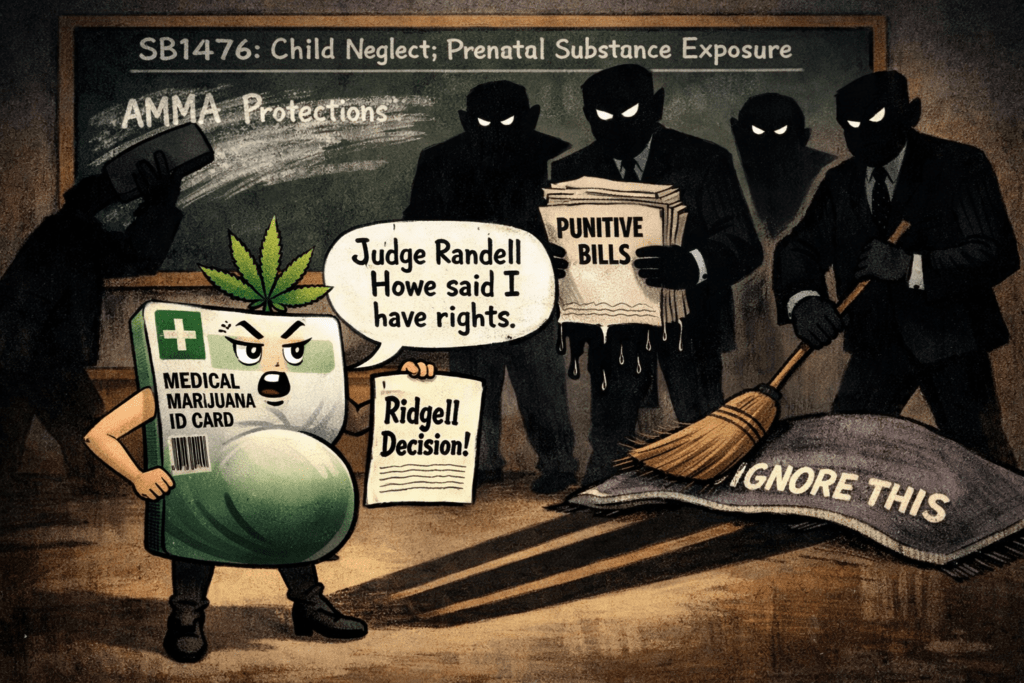
Lawmakers did not mention the Arizona Medical Marijuana Act (AMMA) in the bill, even though the AMMA protects qualified patients who use cannabis as medicine. That omission raises concerns because the Arizona Court of Appeals already addressed this issue in Ridgell v. Department of Child Safety.
In that case, Ridgell, a pregnant DCS caseworker and registered medical marijuana patient, used medical cannabis to manage severe vomiting caused by hyperemesis gravidarum during her pregnancy. After she gave birth, the Department of Child Safety tried to place her name on the state’s Central Registry, a list reserved for substantiated child abuse or neglect cases. Placement on that registry would have prevented her from working with vulnerable populations, including children, the elderly, and people with disabilities, effectively undermining her career in social work.
The case went to the Arizona Court of Appeals, where Judge Randall Howe ruled that the state must treat medical marijuana patients the same as patients who use any other lawful prescription medication. The court decided that DCS cannot label lawful cannabis use as child neglect while a patient has a valid medical marijuana card. S.B. 1476 does not directly address or clarify those protections.
Other states have taken similar approaches, and their experiences shape the current debate. Alabama used its “chemical endangerment” law to prosecute pregnant women for substance exposure, which led to a surge in arrests and strong objections from medical experts. South Carolina pursued prosecutions under child‑abuse statutes for prenatal drug exposure. Tennessee enacted a law that directly criminalized drug use during pregnancy; reports later showed that pregnant patients avoided prenatal care, and lawmakers allowed that statute to expire after two years. Courts in Oklahoma and Georgia have issued mixed rulings, and Wisconsin continues to face constitutional challenges over its fetal‑protection law.
Major medical organizations, including the American College of Obstetricians and Gynecologists, the American Medical Association, and the American Public Health Association, have reviewed the data from these states. They have consistently concluded that criminal penalties for prenatal substance exposure discourage patients from seeking prenatal care and worsen health outcomes.
Arizona voters approved AMMA to protect qualified medical‑cannabis patients from criminal penalties for lawful use. The Ridgell decision reinforced those protections. As S.B. 1476 moves through the House Judiciary Committee, lawmakers must decide whether this new felony offense strengthens child welfare policy or risks repeating outcomes that other states have already experienced.