
It has been a busy week at the Arizona Legislature. Lawmakers have sidelined nearly every cannabis-related bill that once seemed likely to move forward. At this point, only three measures remain alive, and all three could still reach the governor’s desk.
SB 1641 Advances After Licensing Battle
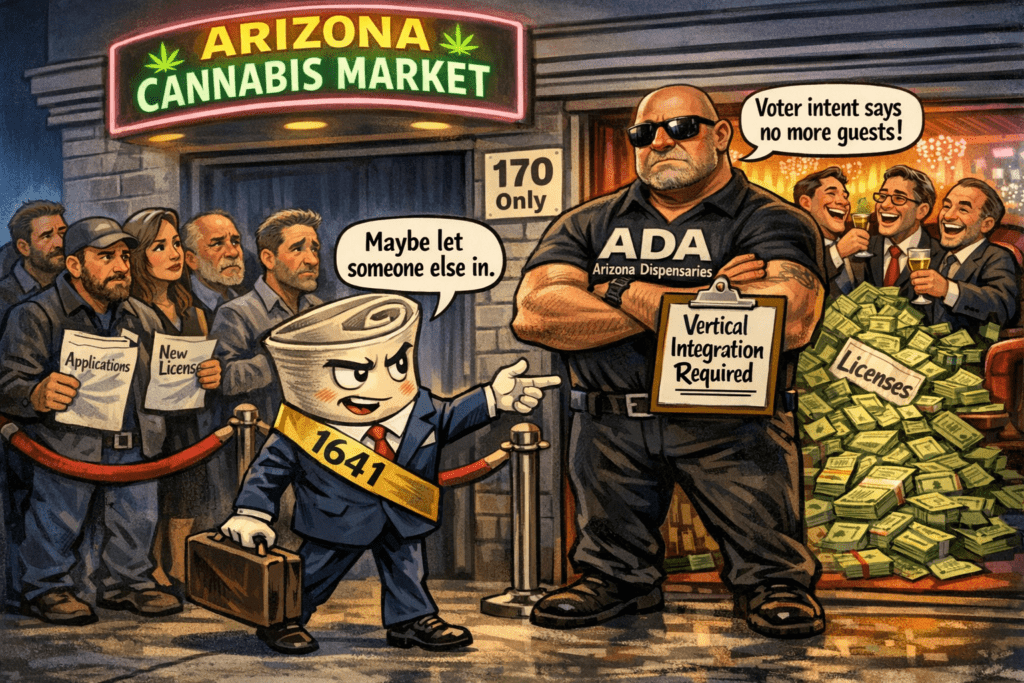
On Tuesday, March 24, the House Commerce Committee approved SB 1641. The bill would dismantle Arizona’s vertically integrated cannabis licensing structure by creating separate cultivation and manufacturing licenses.
During Tuesday’s hearing, the Arizona Dispensaries Association, which represents existing cannabis license holders, sent both its lobbyist and a dispensary license holder to oppose the bill. They repeated a familiar argument: SB 1641, they said, does not advance the purpose of Propositions 203 and 207. They also argued that voters never intended for Arizona’s cannabis industry to expand beyond 170 licenses.
Supporters of the bill, however, made their case effectively and persuaded enough committee members to move the measure forward. The Commerce Committee approved SB 1641 by a 7-3 vote.
SB 1476 Ignites Clash Over Pregnancy and Criminal Penalties
Wednesday, March 25th, brought even more legislative maneuvering. After a round of shifting committee schedules that seemed designed to create confusion, the House Judiciary Committee heard SB 1725 and SB 1476.
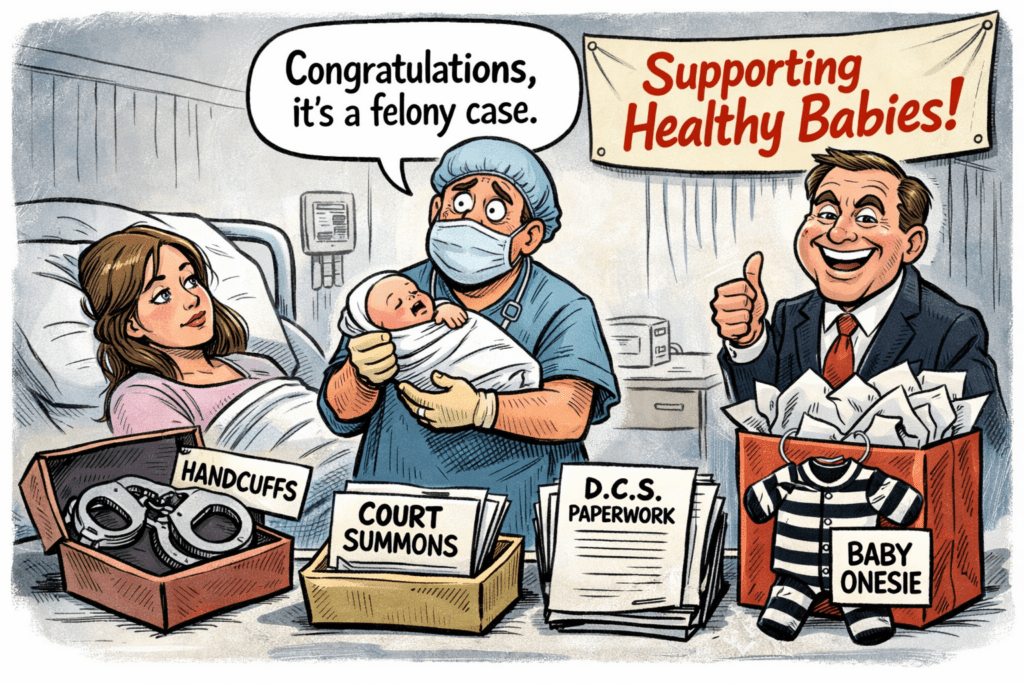
SB 1476 would make prenatal substance exposure a felony. The committee approved the bill on Wednesday by a 4-2-1 vote.
Supporters say the measure would improve infant health and protect babies from the dangers of substance exposure during pregnancy. Opponents warn that the bill could do the opposite. They argue that criminal penalties often drive pregnant women away from prenatal care, addiction treatment, and honest communication with medical providers. In practice, they say, the bill could increase risks for both mothers and babies rather than reduce them.
Critics often point to Tennessee, where officials enforced a similar law and some pregnant women reportedly skipped prenatal appointments and avoided medical care because they feared arrest or prosecution. In Arizona, those concerns carry even more weight because voters legalized adult-use cannabis in 2020, yet SB 1476 does not exempt marijuana from its reach.
If lawmakers enact the bill, some parents could face two fights at once: one against the Department of Child Safety over custody of their children, and another in the criminal justice system as they try to avoid prosecution, conviction, and possible prison time.
SB 1725 Sparks Outrage Over Marijuana Odor Lawsuits
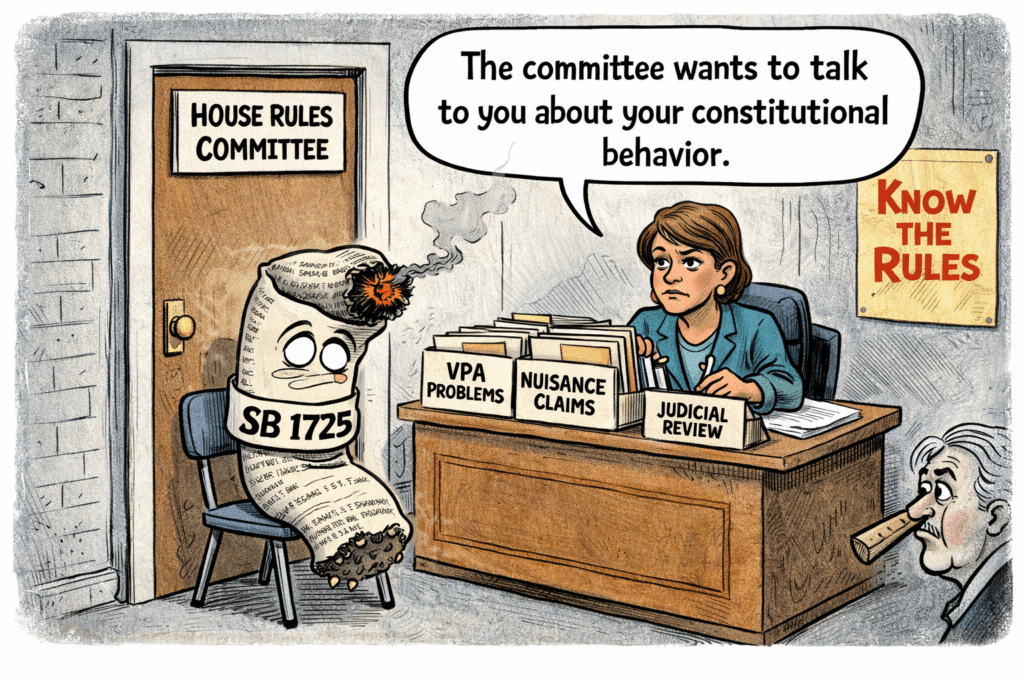
SB 1725 has also emerged as one of the session’s most closely watched and most controversial bills. The measure would allow neighbors to sue over private cannabis use if marijuana odor interferes with their use and enjoyment of their property.
The proposal has drawn both legal and political scrutiny. Many critics see it as absurd, and others argue that it collides with three voter-approved initiatives. That conflict raises serious questions about whether lawmakers can advance the bill without the three-fourths supermajority that Arizona’s Voter Protection Act requires for changes that undermine voter-approved laws. Opponents argue that if the bill had faced that higher threshold from the beginning, it likely would not have made it this far.
The House Judiciary Committee moved SB 1725 forward on Wednesday by an 8-1-1 vote. The bill now heads to the Rules Committee, where lawmakers will likely examine those constitutional concerns more closely.


Critics argue that SB 1725 clashes with the limits the Arizona Supreme Court outlined in State v. Maestas. Under the Voter Protection Act, lawmakers cannot weaken, restrict, or effectively recriminalize conduct that voters have legalized unless the change furthers the purpose of the voter-approved law and wins the required supermajority vote. That issue carries major significance in Arizona cannabis law, especially under the Arizona Medical Marijuana Act and Proposition 207.
Much of the criticism centers on the bill’s language stating that “lawful possession or use of marijuana does not preclude a finding of nuisance.” Opponents argue that lawmakers cannot take conduct voters explicitly legalized, relabel it as a nuisance, and then punish it anyway. In their view, SB 1725 creates a backdoor path to penalize lawful marijuana use under a different name.
Critics have also raised alarms about enforcement. The bill would make failure to comply with a court order a petty offense and would treat each day of noncompliance as a separate violation. Opponents argue that this structure creates an indirect but very real way to criminalize conduct that voters chose to protect. They believe the measure invites a serious constitutional challenge if it becomes law.
Legal showdown looms in House Rules Committee
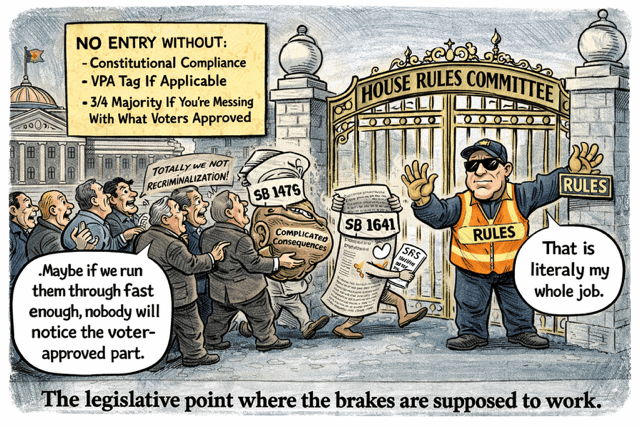
Next week, two of the three remaining cannabis-related measures SB 1476 and SB 1725 will go before the House Rules Committee. The House Rules Committee serves as the Legislature’s legal gatekeeper. It reviews bills before they reach the floor to make sure they comply with the Arizona and U.S. Constitutions and with legislative rules.
Attorneys who work with the committee play an advisory role. They analyze each measure, identify legal or constitutional concerns, and alert lawmakers when a bill appears to affect a voter-approved initiative or referendum protected by Arizona’s Voter Protection Act. If that happens, the lawyers cannot add a VPA tag themselves or amend the bill. Instead, a lawmaker must offer an amendment to add VPA language to the measure.
Once the chamber adopts that amendment, the bill becomes subject to the Voter Protection Act’s higher standard. Lawmakers then must show that the measure furthers the purpose of the original voter-approved law and must pass it with a three-fourths supermajority in each chamber. If no member adds that amendment, the bill may still move through the process, but it remains vulnerable to significant legal challenges if it conflicts with voter-approved protections.
Committees This Week
SB 1476 – Child Neglect; Prenatal Substance Exposure
House Rules Committee
Monday, March 30th, 1pm
SB 1725 – Marijuana Smoke; Public; Private Nuisance
House Rules Committee
Monday, March 30th, 1pm
Details
SB1476 Child Neglect; Prenatal Substance Exposure
01/29/2026 Senate First Read
01/29/2026 Assigned Senate Judiciary and Elections
02/02/2026 Senate Second Read
02/18/2026 Passed Senate Judiciary and Elections (4-2-1)
02/23/2026 Passed Senate Rules
02/23/2026 Senate Caucus
02/26/2026 Senate(COW) Committee Of Whole
02/26/2026 Passed Senate Third Read (16-14-1)
02/27/2026 Transmit to House
03/09/2026 House First Read
03/09/2026 Assigned House Judiciary Committee
03/10/2026 House Second Read
3/25/2026 Passed House Judiciary Committee (6-2-1)
3/30/2026 Monday House Rules Committee 1pm
Makes it a crime of child neglect in Arizona by making it a Class 6 felony for a person who has custody of a child to engage in conduct that harms the child and constitutes neglect as defined in existing law. It also establishes an affirmative defense for the child’s mother if she completed alcohol or drug treatment during pregnancy.
Sections Affected:
13-3619.01 Added
Sponsor:
Bolick Prime
Voter Protection Act Prop 103- No (but might need to be)
Senate Engrossed Version
SB 1641 Marijuana Producers; Licensure
01/30/2026 Introduced Senate
02/05/2026 Senate First Read
02/05/2026 Assigned Senate Regulatory Affairs and Government Efficiency (RAGE)
02/18-2026 Passed Senate Regulatory Affairs and Government Efficiency (RAGE) (vote 8-0-0)
03/11/2026 Due Pass Senate Rules
03/11/2026 Caucus
03/11/2026 Due Pass as Amended Senate (COW) Committee Of Whole
03/11/2026 Passed Senate Third Read (23-5-2)
03/16/2026 House First Read
03/16/2026 Assigned House Commerce Committee
03/17/2026 House Second Read
03/24/2026 Passed House Commerce Committee (7-3)
A marijuana producer is a licensed entity that can cultivate, process, manufacture, package, and store marijuana and marijuana products at a single location, but cannot sell or transfer them directly to consumers. Applications for these licenses will open on January 1, 2029, but until January 1, 2032, only entities with contracts established by January 1, 2026 with a marijuana establishment, nonprofit dispensary, or management company are eligible. During this period, licenses cannot be transferred or subleased, and unlicensed entities are prohibited from cultivating or manufacturing at producer sites. Beginning in 2030, the department will review market conditions annually and may issue additional licenses if it determines consumers would benefit. Marijuana producers are subject only to the same rules as marijuana establishments unless the law specifically provides otherwise.
Sections Affected:
36-2850 Amended
36-2854 Amended
36-2857 Amended
36-2858 Amended
36-2859 Amended
36-2860 Amended
36-2861 Amended
36-2864 Amended
36-2865 Amended
Sponsor:
Payne
VPA- Voter Protection Act (Prop 105): Yes
MORE INFO
SENATE FACT SHEET: 02/16/2026 RAGE
Adopted Amendments Senate
SENATE FACT SHEET: 03/11/2026 RAGE As Passed COW
SB1725: Marijuana Smoke; Public; Private Nuisance
**Scheduled House Judiciary Committee Wednesday March 25th 9am**
02/04/2026 Senate Introduced
02/05/2026 Senate First Read
02/05/2026 Assigned Senate Judiciary (JUD)
02/20/2026 Passed Senate Senate Judiciary and Elections (JUDE) (vote 5-2-0)
02/25/2026 Passed Senate Rules (5-4-0)
02/25/2026 Senate Caucus
03/03/2026 Due Passed as Amended Senate (COW) Committee Of Whole
03/09/2026 Senate Third Read Passed (20-9-1)
03/16/2026 House First Read
03/16/2026 Assigned House Judiciary Committee
03/17/2026 House Senond Read
3/25/2026 Passed House Judiciary Committee (8-1-0-1)
03/30/2026 House Rules Committee 1pm
Expands Arizona’s nuisance laws to explicitly treat excessive marijuana smoke and odor as a type of “crime” for purposes of declaring a residential property a nuisance, allowing affected residents, homeowner/property owner associations, and government attorneys to sue to abate the activity, with notice procedures and potential cost liens if an owner who knows about the activity fails to act. The bill also amends the criminal and public nuisance statutes to create presumptions that producing excessive marijuana smoke and odor endangers others’ health/safety (criminal nuisance) and is injurious, offensive, and interferes with property enjoyment (public nuisance)
Sections Affected:
12-991 Amended
13-2908 Amended
13-2917 Amended
Sponsor:
Mesnard
VPA- Voter Protection Act (Prop 105)– NO, but should be
MORE INFO
SENATE FACT SHEET: 02/16/2026 JUDE
SENATE FACT SHEET: 03/03/2026 JUDE As Passed COW
Senate Engrossed Version