


Arizona lawmakers have hit a wall on cannabis legislation. The Legislature took several days off between April 3 and April 6, and activity this week has focused on Committee of the Whole (COW) debates for bills that cleared Rules weeks ago. Lawmakers have not advanced any of the pending cannabis measures during that time. Two measures now wait for a hearing in Committee of the Whole (COW), and both appear likely to move once leadership schedules them.

The bigger question surrounds the bills still sitting for House Rules. Those measures face a more uncertain path, as delays at that stage often signal deeper concerns about votes, legal issues, or behind-the-scenes opposition.
Opening The Market Stalls in Rules… Again
The two bills that expand Arizona’s cannabis market have stalled in House Rules, and that is not just a routine delay. It mirrors a strategy already used in the Senate.
In the Senate, leadership held similar cannabis expansion bills in Rules rather than advancing them. That changed when SB1641 broke through and crossed over in a single day.SB 1363 did not get that same path. The delay forced a workaround. Representative Livingston took Senator Gowan’s SB 1128, stripped its original language, and inserted new text through a striker amendment. That move converted a bill focused on scrap metal studies into the Rural Marijuana Opportunity Initiative, now SB1128. Now the question shifts to the House. Lawmakers must decide whether these measures will move out of Rules or fade away. That sequence shows how Rules functions in practice. It does not just review bills for legal form. It acts as a gatekeeper.
At the same time, SB1641, the marijuana producer license measure, avoided fading away in Senate Rules. It moved out of Senate Rules at the last possible moment going from Rules to passing and crossing over to the House in a day. So what is actually holding things up?
What Is Actually Driving the Stall
Earlier committee hearings offered a clear signal about what may be driving the current stall.The Arizona Dispensaries Association opposed the expansion bills during House standing committee hearings. The group argued that the measures do not “further the purpose” of Proposition 207 and stated that both proposals should not have advanced out of Senate Rules.
Now similar delays have emerged in the House. The pattern suggests more than coincidence. It points to influence.
Winners and Weak Spots
Among the expansion bills, SB 1641 stands out as the measure that pushed past the Senate Rules gatekeeper and now holds the clearest path forward. The bill does not add new dispensaries, which makes it easier to defend politically. That narrower scope likely helped it move where broader proposals stalled. If SB 1641 reaches the House floor, it still faces a tight vote count but retains a narrow path to securing the required three fourths majority.
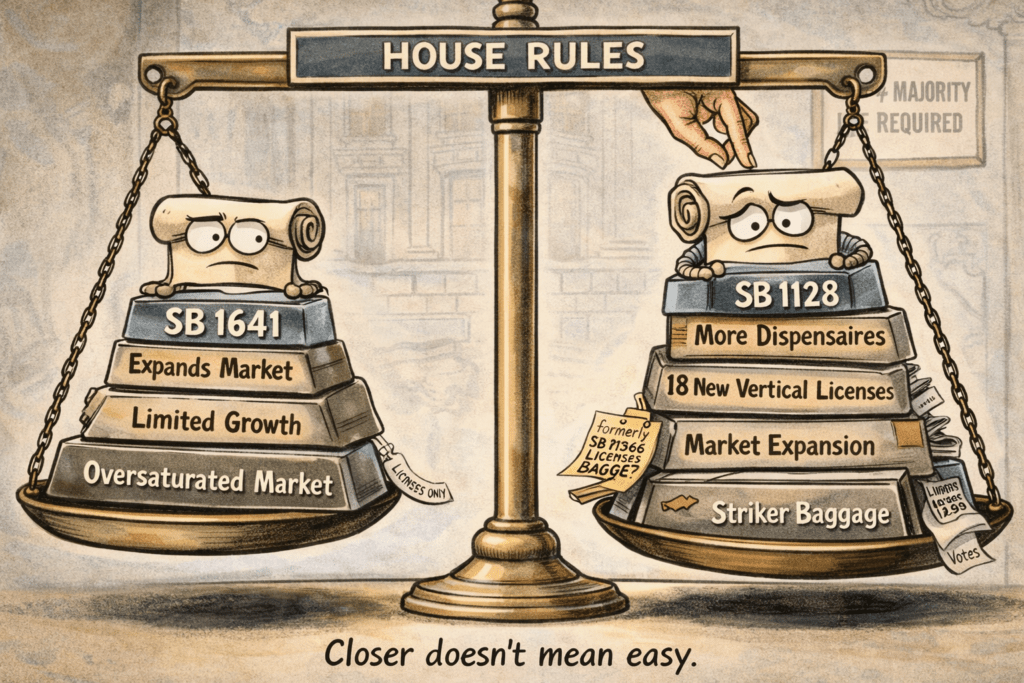
SB 1128 sits in a much weaker position. Its numbers in Appropriations told the story. That bill does not have the votes, and nothing since then suggests that changed.
Waiting For The Floor
Then you have the bills that already cleared House Rules and now wait for the Committee of the Whole. COW gives lawmakers one last chance to amend a bill before final passage.
SB 1476 falls into that group.The measure would make prenatal substance exposure a felony. It does not meet the three fourths vote threshold, but it does not need to. Even if every Democrat votes no, the Republican majority still has enough votes to pass it. The bigger question comes after the vote. Governor Katie Hobbs has shown a pattern of vetoing bills that lack bipartisan support. SB 1476 appears headed for a party-line vote, which puts it directly in that category.
SB 1725 Becomes the Legal Test
SB 1725 is where this session turns into a legal test. House Rules already flagged the issue. The Rules attorney raised the three fourths requirement because SB 1725 operates as an indirect amendment that effectively acts like a direct one. It limits the scope of both Proposition 207 and Proposition 203. That triggers the Voter Protection Act whether lawmakers want to admit it or not.
So now the Legislature faces a choice.
If lawmakers respect that analysis and amend the bill to meet the three fourths threshold, SB 1725 dies. The votes are not there. If they ignore it, push forward anyway, and treat it like a simple majority bill, it passes. That is not a gray area. That is a fork in the road.
COW gives them the mechanism to make that call. Senator Mesnard can accept a friendly amendment and bring the bill into compliance. Or someone, likely from the minority but not always, can force the issue with a hostile amendment on the floor. Either way, the moment lawmakers touch that amendment, they answer the real question. Do they follow the Voter Protection Act, or do they dare the courts to clean it up later?
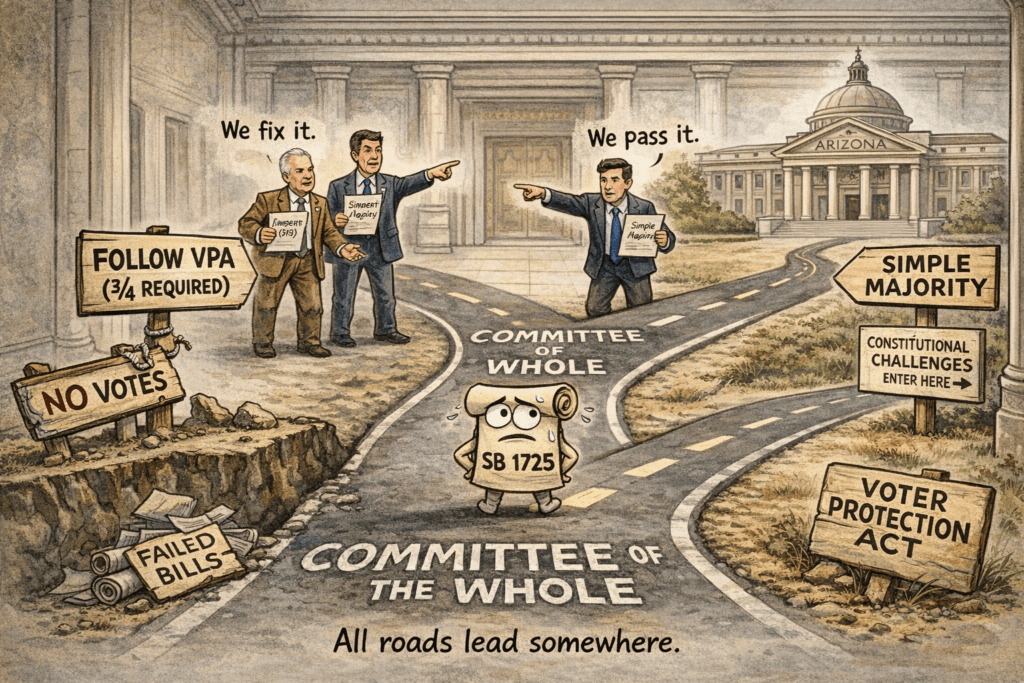

Because if SB 1725 passes and the governor signs it, this does not end at the Capitol. That bill walks straight into a constitutional fight before it ever has a chance to function in the real world.
What Happens Next
Right now, movement depends on process as much as policy. Some bills wait for a hearing in the Committee of Whole. Others remain held in Rules. And a few raise larger questions about how lawmakers will handle voter approved laws. What happens next will depend on whether those measures move forward or remain stalled at the gate.

At A Glance
SB1725- Marijuana Smoking Nuisance
Waiting on House Committee Od Whole
SB1476- Prenatal Substance Abuse Felony
Waiting on House Committee Od Whole
SB1641- Marijuana Producer Licenses
Waiting on House Rules
SB1128- (newly) Marijuana Rural Licenses
Waiting on House Rules
Details
SB1476 Child Neglect; Prenatal Substance Exposure
Waiting on House Committee Of Whole (COW)
01/29/2026 Senate First Read
01/29/2026 Assigned Senate Judiciary and Elections
02/02/2026 Senate Second Read
02/18/2026 Passed Senate Judiciary and Elections (4-2-1)
02/23/2026 Passed Senate Rules
02/23/2026 Senate Caucus
02/26/2026 Senate(COW) Committee Of Whole
02/26/2026 Passed Senate Third Read (16-14-1)
02/27/2026 Transmit to House
03/09/2026 House First Read
03/09/2026 Assigned House Judiciary Committee
03/10/2026 House Second Read
3/25/2026 Passed House Judiciary Committee (6-2-1)
3/30/2026 Passed House Rules Committee (8-0)
Makes it a crime of child neglect in Arizona by making it a Class 6 felony for a person who has custody of a child to engage in conduct that harms the child and constitutes neglect as defined in existing law. It also establishes an affirmative defense for the child’s mother if she completed alcohol or drug treatment during pregnancy.
Sections Affected:
13-3619.01 Added
Sponsor:
Bolick Prime
Voter Protection Act Prop 103- No (but might need to be)
Senate Engrossed Version
SB 1641 Marijuana Producers; Licensure
Waiting on House Rules
No Movement
01/30/2026 Introduced Senate
02/05/2026 Senate First Read
02/05/2026 Assigned Senate Regulatory Affairs and Government Efficiency (RAGE)
02/18-2026 Passed Senate Regulatory Affairs and Government Efficiency (RAGE) (vote 8-0-0)
03/11/2026 Due Pass Senate Rules
03/11/2026 Caucus
03/11/2026 Due Pass as Amended Senate (COW) Committee Of Whole
03/11/2026 Passed Senate Third Read (23-5-2)
03/16/2026 House First Read
03/16/2026 Assigned House Commerce Committee
03/17/2026 House Second Read
03/24/2026 Passed House Commerce Committee (7-3)
A marijuana producer is a licensed entity that can cultivate, process, manufacture, package, and store marijuana and marijuana products at a single location, but cannot sell or transfer them directly to consumers. Applications for these licenses will open on January 1, 2029, but until January 1, 2032, only entities with contracts established by January 1, 2026 with a marijuana establishment, nonprofit dispensary, or management company are eligible. During this period, licenses cannot be transferred or subleased, and unlicensed entities are prohibited from cultivating or manufacturing at producer sites. Beginning in 2030, the department will review market conditions annually and may issue additional licenses if it determines consumers would benefit. Marijuana producers are subject only to the same rules as marijuana establishments unless the law specifically provides otherwise.
Sections Affected:
36-2850 Amended
36-2854 Amended
36-2857 Amended
36-2858 Amended
36-2859 Amended
36-2860 Amended
36-2861 Amended
36-2864 Amended
36-2865 Amended
Sponsor:
Payne
VPA- Voter Protection Act (Prop 105): Yes
MORE INFO
SENATE FACT SHEET: 02/16/2026 RAGE
Adopted Amendments Senate
SENATE FACT SHEET: 03/11/2026 RAGE As Passed COW
SB1725: Marijuana Smoke; Public; Private Nuisance
Waiting on House Committee of Whole (COW)
02/04/2026 Senate Introduced
02/05/2026 Senate First Read
02/05/2026 Assigned Senate Judiciary (JUD)
02/20/2026 Passed Senate Senate Judiciary and Elections (JUDE) (vote 5-2-0)
02/25/2026 Passed Senate Rules (5-4-0)
02/25/2026 Senate Caucus
03/03/2026 Due Passed as Amended Senate (COW) Committee Of Whole
03/09/2026 Senate Third Read Passed (20-9-1)
03/16/2026 House First Read
03/16/2026 Assigned House Judiciary Committee
03/17/2026 House Senond Read
3/25/2026 Passed House Judiciary Committee (8-1-0-1)
03/30/2026 Passed House Rules Committee (5-3-0)
Expands Arizona’s nuisance laws to explicitly treat excessive marijuana smoke and odor as a type of “crime” for purposes of declaring a residential property a nuisance, allowing affected residents, homeowner/property owner associations, and government attorneys to sue to abate the activity, with notice procedures and potential cost liens if an owner who knows about the activity fails to act. The bill also amends the criminal and public nuisance statutes to create presumptions that producing excessive marijuana smoke and odor endangers others’ health/safety (criminal nuisance) and is injurious, offensive, and interferes with property enjoyment (public nuisance)
Sections Affected:
12-991 Amended
13-2908 Amended
13-2917 Amended
Sponsor:
Mesnard
VPA- Voter Protection Act (Prop 105)– NO, but should be
MORE INFO
SENATE FACT SHEET: 02/16/2026 JUDE
SENATE FACT SHEET: 03/03/2026 JUDE As Passed COW
Senate Engrossed Version
SB1128 (now) Marijuana Rural Opportunity Initiative
03/31/2026 Striker Passed House Appropriations Committee (10-7-2)
To establish the Rural Opportunity Initiative (ROI), which authorizes the Arizona Department of Health Services to issue up to 18 marijuana establishment licenses and 18 corresponding nonprofit medical marijuana dispensary registration certificates to create new dual licensees in qualifying unserved rural communities — defined as cities, towns, or census-designated areas with populations under 50,000 that contain parcels located at least 25 miles from an existing marijuana retail location. Applications are accepted electronically April 1–14, 2027, reviewed in time-stamp order, and subject to a structured approval process requiring property ownership documentation, local zoning compliance, background attestations, and good standing with the Corporation Commission. ROI licensees must open within 18 months of license issuance, operate a minimum of 24 hours per week, and may only relocate to another qualifying unserved rural community that has not opted out. Cities, towns, and counties may opt out of the ROI by submitting certified resolutions to the Department at least one month before the application period opens. The legislation also expands existing marijuana establishment licensing rules, including 26 additional licenses under a Social Equity Ownership Program, and mandates that the Department adopt rules by January 1, 2025 to regulate marijuana delivery, with unauthorized delivery subject to a $20,000 civil penalty per violation enforceable by the Attorney General.
Original Sponsor- Gowan
Amendment Sponsor -Livingston
VPA. 3/4 voter requirement- YES
HOUSE – Appropriations – Strike Everything