

Week three at the Capitol brings momentum, with Senator Payne, a Republican from Legislative District 27, introducing two cannabis-related bills. Both measures signal serious movement on marijuana policy. Here’s a closer look.
Arizona Expands Medical Marijuana Access and Boosts Safety Standards
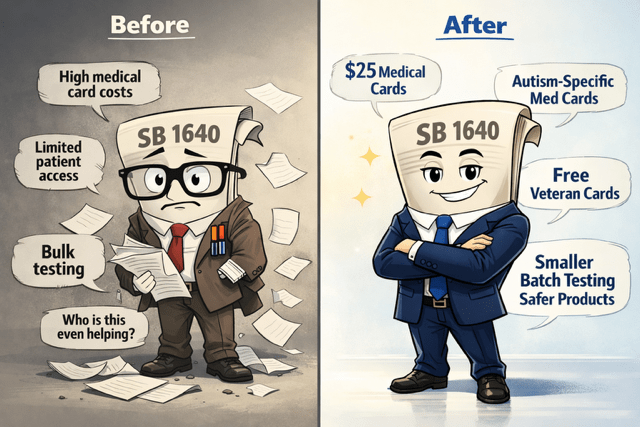
Senator Payne introduced SB 1640, Marijuana; Qualifying Illnesses; Testing; Complaints, on Friday afternoon. The bill delivers a long-awaited update to the Arizona Medical Marijuana Act under Proposition 203. SB 1640 expands patient access, lowers costs, and strengthens safety and transparency across the state’s medical marijuana program.
The bill adds several new qualifying conditions, including PTSD, autism spectrum disorder with specific requirements, uterine fibroids, endometriosis, and ovarian cysts. These additions open the program to thousands of new patients. SB 1640 also caps medical marijuana card fees at $25 and removes the fee entirely for honorably discharged military veterans.
SB 1640 raises product safety standards by tightening testing and labeling rules. The bill requires clearer batch definitions, unique batch numbers, standardized lab testing, and faster reporting of results. Patients can scan QR codes on product packaging to view official certificates of analysis. Starting in 2028, the state will conduct random third-party testing to confirm that products on dispensary shelves match their lab results.
The bill also increases accountability. It makes substantiated complaints against dispensaries and testing labs publicly available while protecting the identities of those who file complaints. In addition, SB 1640 directs medical marijuana fund revenue toward FDA-approved clinical research. The bill allocates up to $5 million per year for five years to study marijuana’s safety and effectiveness.
Overall, SB 1640 delivers meaningful updates to Arizona’s medical marijuana program and addresses long-standing concerns around access, affordability, and consumer protection.
SB 1641 Creates New Marijuana Producer License
Senator Payne released another bill this week, SB 1641 Marijuana Producers; Licensure. SB 1641 defines a “marijuana producer” as a licensed business that grows, processes, and packages marijuana and marijuana products at one licensed location. A producer may manufacture products such as concentrates and edibles. Under the bill, marijuana producers may sell products only at the wholesale level to licensed retailers and processors.
The bill limits who may apply for a marijuana producer license during the first phase. Only entities that already held contracts to grow or produce cannabis under a medical or recreational license as far back as 2026 may apply. This application window runs from January 1, 2029, through January 1, 2032.
After January 1, 2032, SB 1641 allows broader access, but only if licenses remain available. Beginning in 2030, the Arizona Department of Health Services will conduct annual market reviews. The department will issue new marijuana producer licenses only if it determines that additional licenses would benefit consumers, such as by lowering prices or increasing product variety.
The bill leaves several key questions unanswered. It does not explain how the state will issue producer licenses, whether the process will follow a lottery system or how much it will cost to apply.
What will next week bring? With momentum building around cannabis legislation, attention now turns to whether the Arizona Dispensaries Association will step into the spotlight. So far, no measures tied directly to the group have surfaced, leaving questions about how dispensaries plan to shape the debate. As lawmakers continue to move bills at a fast pace, next week could reveal whether the industry’s most powerful trade group plans to push new proposals, respond to pending legislation, or stay on the sidelines as the session heats up. However, staying on the sidelines doesn’t fit them.
DETAILS
HB2081-Medical Marijuana; Terminal Illness (Ryan’s Law)
No Movement
Pre filed Intro
01/12/2026 House First Read
01/13/2026 Second Read
01/13/2026 Assigned House Health and Human Services Committee
The proposal, titled Ryan’s Law, would update Arizona’s medical marijuana statute by clarifying definitions and expanding protections for qualifying patients, particularly those with terminal illnesses. The measure would maintain existing possession and cultivation limits for patients and caregivers, refine eligibility standards for caregivers and dispensary agents, and reaffirm restrictions related to prior violent or serious felony convictions. It would also require licensed health care facilities to allow terminally ill patients to use medical marijuana in designated areas, prohibit smoking or vaping, include marijuana use in medical records, and permit reasonable storage and safety restrictions, unless compliance would jeopardize federal funding or licensing. Other facilities could still adopt reasonable limits on use, but could not unreasonably deny access. The changes would take effect only with approval by a three‑fourths vote of each chamber of the Legislature.
Sections Affected:
36-2801 Amended
36-2805 Amended
Sponsor: Bliss
VPA- Voter Protection Act (Prop 105): Yes
MORE INFO
HB 2632: Landlords; Tenant’s Marijuana Use
No Movement
01/15/2026 Introduced House
1/20/2026 House First Read
1/21/2026 House Second Read
1/20/2026 Assigned House Commerce Committee
The measure would prohibit landlords from terminating a rental agreement solely because a tenant uses marijuana.
Sections Affected:
33-1317.01 Added
Sponsor:
Austin Prime
Garcia Co-Sponsor
Sandoval Co-Sponsor
Villegas Co-Sponsor
VPA- Voter Protection Act (Prop 105): Yes
MORE INFO
HB2801: Marijuana Convictions; Misdemeanors; Fines; Assessments
No Movement
01/15/2026 Introduced House
01/20/2026 House First Read
01/20.2026 Assigned House Judiciary Committee
01/21/2026 House Second Read
The legislation would expand and clarify Arizona’s marijuana expungement law, allowing individuals with certain low‑level marijuana offenses committed before November 30, 2020, to petition courts to erase their criminal records. Eligible offenses include limited possession, small‑scale home cultivation, and marijuana paraphernalia. Courts would notify prosecutors, hold hearings if needed, and grant expungement unless prosecutors prove ineligibility. Approved petitions would vacate convictions, seal records, restore civil rights, and prevent expunged offenses from being used in future prosecutions, with the measure taking effect only if three‑fourths of lawmakers in each chamber approve it.
Sections Affected:
36-2862 Amended
Sponsor:
Volk
VPA- Voter Protection Act (Prop 105): Yes
MORE INFO
HCR2029: Marijuana; Unincorporated Areas; Reservations; Prohibition
No Movement
01/15/2026 Introduced House
HCR 2029 would send a measure to Arizona voters that bars the state from issuing medical or adult‑use marijuana licenses in unincorporated areas completely surrounded by Indian reservations. The proposal would prohibit nonprofit medical marijuana dispensaries, marijuana establishments, and marijuana testing facilities from operating in these locations, effectively limiting cannabis businesses in so‑called “county islands” encircled by tribal land, with voters deciding the issue at the next general election.
Sponsor:
Peshlakai Prime
Austin Co-Sponsor
Cavero Co-Sponsor
Connolly Co-Sponsor
Liguori Co-Sponsor
Márquez Co-Sponsor
Sandoval Co-Sponsor
Villegas Co-Sponsor
VPA- Voter Protection Act (Prop 105): No (goes to ballot)
MORE INFO
HCR2037 Marijuana; Conviction Exclusion; Cultivation
(The Arizona Marijuana Alignment and Public Safety Act)
No Movement
01/15/2026 Introduced House
The Arizona Marijuana Alignment and Public Safety Act would update state marijuana law by tightening licensing requirements, regulating cultivation, and preparing for potential federal changes. The proposal would bar individuals with violent crime convictions from owning or controlling marijuana businesses and require regulators to deny or revoke licenses for violations. It would set a standard cultivation canopy of 15,000 square feet per license, allow approved shared canopy agreements, and establish enforceable limits on residual solvents in marijuana products. The measure would prohibit interstate marijuana commerce unless federal law allows it, require a seed‑to‑sale tracking system to prevent diversion, and authorize license suspension or revocation for violations. It would also direct the state to develop a framework for voluntary participation in any future federal marijuana registration system and allow information sharing with federal agencies, with the proposal ultimately going before voters at the next general election.
Sections Affected:
36-2870 Added
36-2871 Added
36-2872 Added
36-2873 Added
36-2874 Added
Sponsor:
Rivero Prime
VPA- Voter Protection Act (Prop 105): No (goes to ballot)
MORE INFO
SB1363: Marijuana; Rural Opportunity Initiative
01/22/2026 Introduced Senate
01/26/2926 Senate First Read
01/26/2026 Assigned Senate Natural Resources
01/27/2027 Senate Second Read
This legislation authorizes 18 new dual-license marijuana permits for communities with fewer than 50,000 residents that sit at least 25 miles from the nearest existing dispensary. The Department of Health Services will grant these licenses to the first qualified applicants who submit timestamped electronic filings, using a random drawing only to break a tie. Although the bill expands the market, it preserves local authority by allowing cities and counties to opt out of the program through a formal resolution. Once they secure a license, business owners must launch their retail sites within 18 months and maintain at least 24 hours of operation per week.
Sections Affected
36-2803.01 Amended
36-2854 Amended
36-2857.01 Added
Sponsor:
Gowan Prime
VPA- Voter Protection Act (Prop 105): Yes
MORE INFO
SB1640 Marijuana; Qualifying Illnesses; Testing; Complaints
01/30/2026 Introduced Senate
Updates to Arizona law affecting naturopathic medicine and the Medical Marijuana Program. It clarifies that naturopathic medicine may only be practiced by a doctor licensed under Title 32. Under Title 36, the bill expands qualifying medical marijuana conditions to include PTSD, autism spectrum disorder (when diagnosed by an MD, DO, or licensed psychologist), and certain gynecological conditions. It caps patient application fees at $25 and exempts honorably discharged U.S. veterans from the fee. SB 1640 also strengthens marijuana testing, batching, labeling, and laboratory oversight by setting limits on batch size and timing, requiring unique batch numbers, standardizing sampling and testing methods, mandating Certificates of Analysis accessible via QR codes on product packaging, and imposing enhanced lab accreditation, proficiency testing, and record‑keeping requirements beginning January 1, 2028. In addition, it requires independent third‑party compliance testing, increases transparency by making substantiated complaints public while protecting complainant identities, and mandates that Medical Marijuana Fund revenues be used for marijuana clinical trial grants, including up to 5 million annually for five years through the Arizona Biomedical Research Centre for FDA‑approved trials.
Sections Affected:
32-1501 Amended
36-2801 Amended
36-2803 Amended
36-2804.02 Amended
36-2817 Amended
36-2822 Amended
36-2854.01 Amended
36-2866 Added
36-2867 Added
Sponsor:
Payne
VPA- Voter Protection Act (Prop 105): Yes
MORE INFO
SB 1641 Marijuana Producers; Licensure
01/30/2026 Introduced Senate
A marijuana producer is a licensed entity that can cultivate, process, manufacture, package, and store marijuana and marijuana products at a single location, but cannot sell or transfer them directly to consumers. Applications for these licenses will open on January 1, 2029, but until January 1, 2032, only entities with contracts established by January 1, 2026 with a marijuana establishment, nonprofit dispensary, or management company are eligible. During this period, licenses cannot be transferred or subleased, and unlicensed entities are prohibited from cultivating or manufacturing at producer sites. Beginning in 2030, the department will review market conditions annually and may issue additional licenses if it determines consumers would benefit. Marijuana producers are subject only to the same rules as marijuana establishments unless the law specifically provides otherwise.
Sections Affected:
36-2850 Amended
36-2854 Amended
36-2857 Amended
36-2858 Amended
36-2859 Amended
36-2860 Amended
36-2861 Amended
36-2864 Amended
36-2865 Amended
Sponsor:
Payne
VPA- Voter Protection Act (Prop 105): Yes
MORE INFO