

The Arizona State Legislature has never been particularly fond of taking “no” for an answer, especially when voters deliver that verdict directly at the ballot box. So when Senate Bill 1725 began its quiet march through the Capitol this session, a bill that would let neighbors sue each other over the smell of legally consumed marijuana, seasoned observers recognized the playbook immediately.
The bill’s journey through the halls of the Arizona Capitol tells a story far bigger than backyard disputes over cannabis odors. It exposes a fundamental tension that has defined Arizona politics for nearly three decades: Who really runs this state, the 4.3 million voters who pass initiatives, or the 90 legislators who write the laws?
The Original Sin: 1996 and the Gutting of the People’s Will
To understand why SB 1725 matters, you have to travel back to November 1996, when Arizona voters did something radical. They passed Proposition 200, the Drug Medicalization, Prevention, and Control Act, with a commanding 65 percent of the vote. The measure allowed physicians to prescribe marijuana for seriously ill patients and mandated treatment instead of prison for first-time drug offenders.
The legislature, overwhelmingly opposed to such progressive ideas, responded with all the subtlety of a sledgehammer.
Legislators simply refused to implement the law. They declined to fund the prescription systems or create the diversion programs, pointing vaguely at federal law as their excuse. Due to ongoing legislative obstruction and legal challenges, the original medical marijuana provisions of Prop 200 never took effect. The legislature had managed to nullify the will of the people through sheer bureaucratic attrition.

What legislators apparently failed to anticipate was that voters possessed both long memories and the ambition to protect themselves.
The Hero: Arizona Builds One of the Nation’s Strongest Voter Shields
In November 1998, Arizona voters approved Proposition 105 and gave birth to the Voter Protection Act, one of the most robust direct democracy safeguards in the nation. The VPA is not a general good-government reform that exists in some form everywhere. It is Arizona’s direct answer to a specific betrayal, and it was built precisely to prevent that kind of legislative end-run from ever happening again.
The Voter Protection Act fundamentally reshaped the balance of power between the legislature and the people. Under its provisions, any lawmaker who wants to amend, add or repeal from a voter-approved law must first secure a three-fourths supermajority in both legislative chambers. That alone is an enormous hurdle, but it does not stop there. Any proposed change must also “further the purpose” of the original initiative. That requirement effectively bars legislators from dismantling the very provisions voters specifically chose to enact, even if they can scrape together the votes.
The 1998 ballot made the stakes crystal clear. The legislature placed its own competing measure, Proposition 104, before the electorate. That proposal would have allowed lawmakers to amend voter initiatives with only a two-thirds majority and without any “further the purpose” requirement. Voters rejected it decisively. Proposition 104 failed with 54.62 percent voting against it. Meanwhile, the Voter Protection Act passed with 52.26 percent in favor.

The message was unmistakable. Arizonans were unwilling to hand their elected representatives broad authority to rewrite laws the people had passed themselves. The VPA was not just a policy choice, it was a declaration.
The Courts Have Taken That Declaration Seriously
If Arizona legislators hoped the courts might offer a more sympathetic interpretation, they were destined for disappointment. A consistent line of decisions over the past two decades has tested the VPA and made one thing clear: when voters pass a law, the legislature cannot simply undo it.
The most important case came in State v. Maestas, where the Arizona Supreme Court struck down a law that banned medical marijuana on college campuses. Voters had already approved the Arizona Medical Marijuana Act. Lawmakers tried to carve out an exception, but the court ruled that move violated the Voter Protection Act. The justices held that the legislature cannot re-criminalize something voters made legal, especially when the change does nothing to support the purpose of the original law.
Other cases have created more nuanced boundaries. In disputes involving the state’s public campaign finance system, including League of Arizona Cities & Towns v. State, courts ruled that not every change connected to a voter-approved law automatically triggers a VPA violation. Judges drew a distinction between major substantive changes and minor technical adjustments, giving lawmakers some room to argue that certain bills merely fine-tune rather than fundamentally alter voter intent.
Funding battles have also tested the limits. When lawmakers attempted to redirect money from voter-approved programs like early childhood education initiatives, courts blocked those efforts unless they met the VPA’s strict constitutional standards.
Even at the federal level, courts reinforced the broader principle that Arizona voters hold real lawmaking power. In Arizona State Legislature v. Arizona Independent Redistricting Commission, the U.S. Supreme Court upheld a voter-created redistricting system and confirmed that citizens can take authority away from the legislature through the ballot.


Taken together, these cases reveal a consistent pattern. Courts will stop lawmakers when they directly undermine voter-approved laws. They leave some space for indirect changes, but only when those changes do not clearly conflict with the original purpose voters intended. That tension now sits at the center of the SB 1725 fight.
The Gray Area: Direct vs. Indirect Amendments
So how does a bill with an apparent Voter Protection Act problem even get this far? Everything turns on classification.
A direct amendment openly changes a voter-approved law. If a bill adds to, removes from, or rewrites sections within Arizona’s marijuana statutes — ARS 36-2801 through 36-2865 — lawmakers must treat it as a VPA matter. That means the bill needs a three-fourths supermajority and must demonstrably further the purpose of the original voter initiative.
An indirect amendment works differently. Lawmakers draft the bill so that it does not technically rewrite the voter-approved statute itself. Instead, it affects how the law operates from the outside. Supporters of SB 1725 argue it falls into that category, which is how they justify moving it forward without a VPA clause or the higher vote threshold.
But Maestas made clear that labels do not control outcomes. Under Arizona law, a bill “amends” a voter initiative when it alters the scope of rights granted by that initiative, even if it does not directly modify the initiative’s text. In Maestas v. State, 417 P.3d 774 (Ariz. 2018), the Arizona Supreme Court considered a statute banning marijuana possession in university dormitories. Although the Legislature placed that restriction in Title 15 rather than amending AMMA directly in Title 36, the Court held that the law still “amended” the initiative because it narrowed rights AMMA had granted. By creating a new place where otherwise lawful possession could be punished, the Legislature violated the Voter Protection Act. That split in case law gives both sides something to argue and it is precisely why bills like SB 1725 can advance through the Capitol even when the constitutional concerns are real and visible..
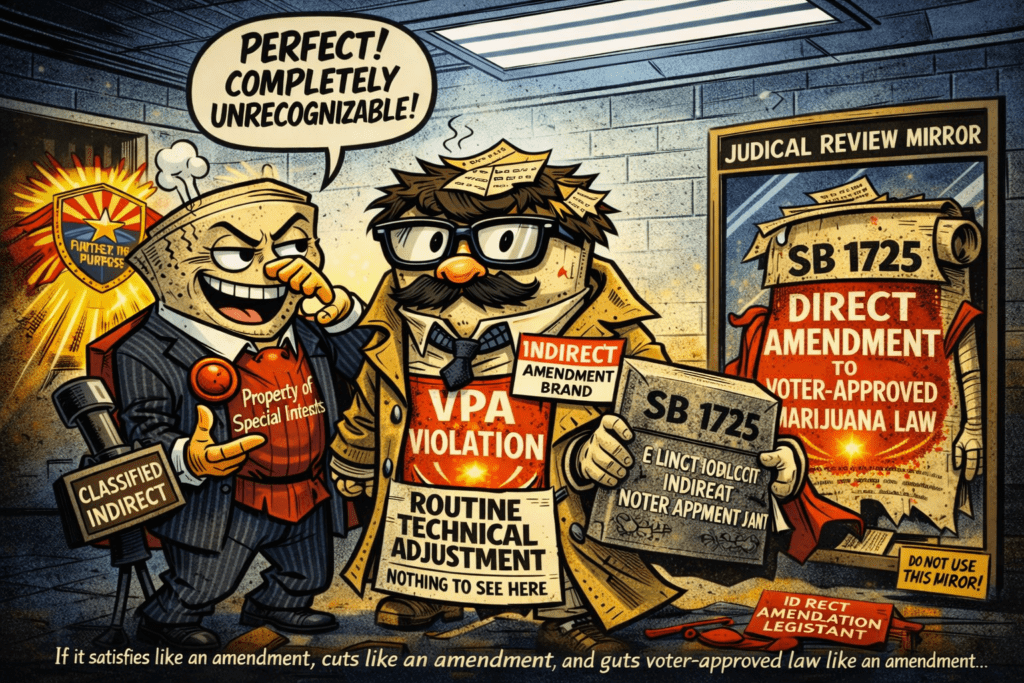
The legislature does not operate like a courtroom. Bills move forward based on internal interpretations, political strategy, and procedural decisions, not judicial rulings. That reality is what allows a bill with serious VPA problems to keep moving.
Behind the Scenes: How SB1725 Got This Far
At the Arizona Capitol, lawmakers write and pass hundreds of bills each year. Behind the scenes, one office plays a key role in shaping those laws: the Arizona Legislative Council. Legislative Council attorneys turn legislators’ ideas into formal legal language and review each proposal for potential conflicts with the Arizona Constitution, including the Voter Protection Act.
However, Legislative Council can advise. It cannot stop a bill.
Lawmakers sometimes advance legislation they know sits in a legal gray area, understanding that any real dispute will ultimately be decided by the courts. SB 1725 appears to be one of those cases. The fact that Senator Mesnard simultaneously released SCR 1048, a now-dead companion measure that would have gone directly to the voters and avoided the VPA conflict entirely, suggests he knew the constitutional tension was real. A lawmaker does not draft a more cautious alternative unless he recognizes the primary bill carries serious risk.
The Warnings Got Louder at Every Stop
Every time SB 1725 appeared in committee, it sparked debate — sometimes over a lack of due process, sometimes over undefined terms, and always over the argument that is uniquely Arizonan: the Voter Protection Act.
Senator Ortiz flagged the VPA conflict in the Senate Judiciary and Elections Committee. Senator Miranda raised it again in the Senate Rules Committee, where the Rules attorney did not flag it. The bill continued moving. It was not until the measure reached the House Rules Committee that the issue was formally identified.
At the Arizona State Legislature, the “Rules Lawyer” is a nonpartisan attorney who reviews legislation before it advances. Their job is to determine whether a bill is in proper legal form and whether it raises constitutional concerns.
During Rules Committee hearings, the attorney may warn lawmakers if a proposal could conflict with state or federal law, including protections under the Voter Protection Act. They also answer technical questions, such as whether a bill counts as a direct amendment to voter-approved law or whether it may require a higher vote threshold.
However, the role is strictly advisory. The Rules Lawyer cannot block, rewrite, or enforce changes to a bill, and does not vote on whether it moves forward. Instead, they place legal concerns on the record while lawmakers decide how to proceed.
That structure means a bill can advance even after legal warnings are raised. If it passes into law, any constitutional issues identified during the Rules process are typically resolved later in court, not at the Capitol.
On March 30th, House Rules legal counsel stated plainly that even though SB 1725 operates as an indirect amendment, it still amends the lawful actions protected under a voter-approved law, and therefore requires a three-fourths supermajority vote. She went further. Even if the bill were amended to include that three-fourths requirement, she said, a second problem remains: SB 1725 does not further the purpose of the voter-approved initiative. In her legal analysis, it fails that test entirely.
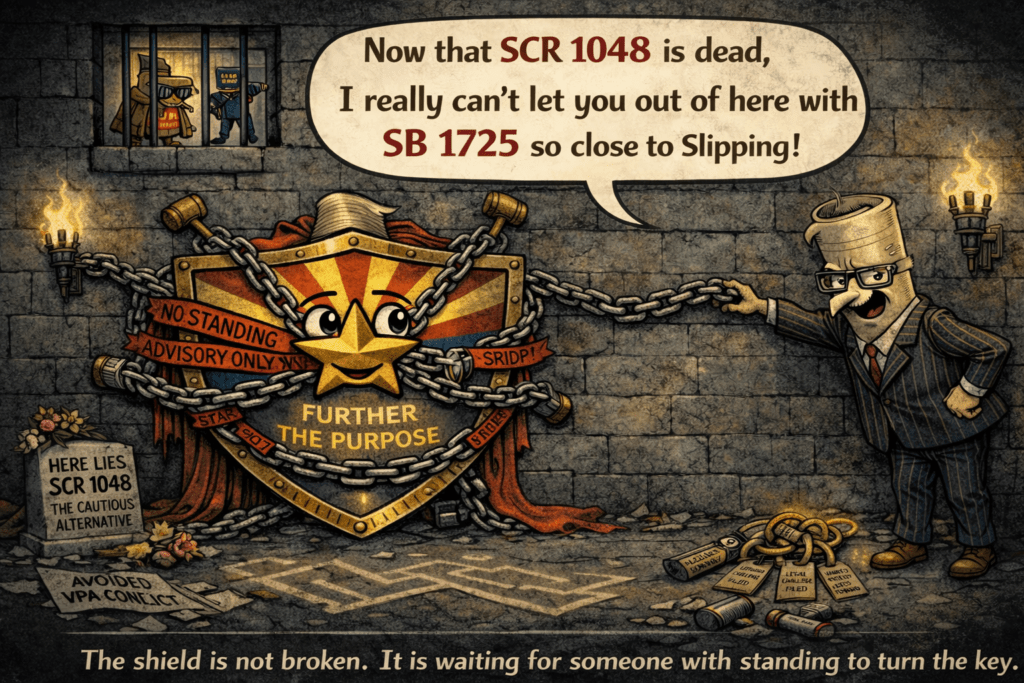
On March 31st, in the House Majority Caucus Democratic representatives in the minority House Caucus spoke to the measure as well, adding their voices to the growing chorus of concern.
Where Does SB 1725 Go From Here?
In a straightforward world, the path forward is simple. SB 1725 gets amended in the Committee of the Whole to include the Voter Protection Act clause, the three-fourths supermajority requirement gets added, and the bill heads to the House floor, where it almost certainly falls well short of the 45 votes it would need to pass.
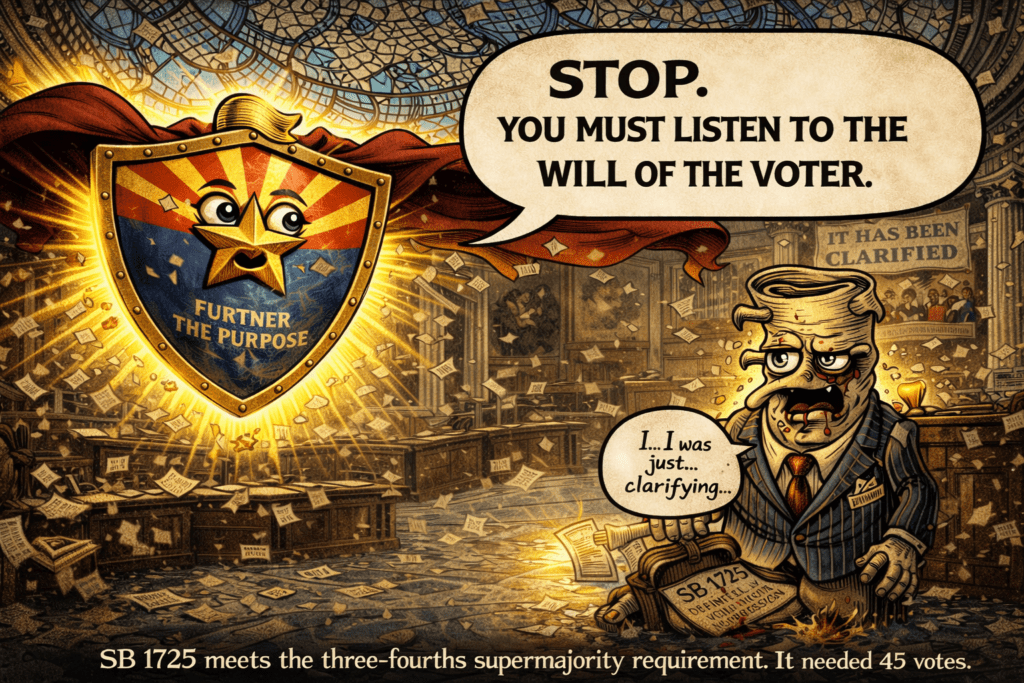
But things are rarely that simple at the Arizona Capitol.
Because SB 1725 is structured as an indirect amendment and case law creates enough ambiguity to argue both sides, some lawmakers may choose to push harder rather than pump the brakes. The bill could move quickly to the governor’s desk as written, bypassing the higher threshold entirely and leaving the constitutional question for the courts to resolve after the fact.
In Arizona, that is often exactly how Voter Protection Act fights play out. The legislature tests the limits. The courts decide where the line actually stands. And voters, the same voters who built this protection because they watched their will get ignored once before are left waiting to find out whether the shield they forged in 1998 still holds.

How Easy Is It to Challenge in Court?
If the Governor signs SB 1725, and if it becomes law without a Voter Protection Act clause, it does not slip past the Constitution, it steps directly into a legal spotlight.
In many ways, that makes it easier to challenge, not harder.
The reason is simple: removing the VPA clause does not remove the constitutional requirement. It only removes the legislature’s acknowledgment of it. That creates a clean legal question for a court to answer, whether the bill functionally amends a voter-approved law without meeting the required three-fourths vote and without furthering the purpose of that law.
Courts in Arizona have repeatedly made clear that they look at substance over form. If SB 1725 changes how voter-approved marijuana laws operate in practice, a challenger does not need the legislature to admit it is a VPA issue. They only need to prove that it acts like one.
That clarity can actually strengthen a lawsuit. Instead of debating legislative intent, the case becomes a direct constitutional test: does the law conflict with what voters approved?
But winning that argument still takes time and a very specific process.

First, someone with legal standing must file the case. That is usually a person, business, or organization directly affected by the law. For SB 1725, that could include individuals facing lawsuits under the new provisions or groups representing affected communities.
Once filed, the case begins in a trial court, where the challenger typically asks for an injunction, a court order to pause enforcement of the law while the case is decided.If a judge grants an injunction, the law can be stopped early. If not, the law remains in effect during the legal fight.
That is the practical reality of how Voter Protection Act disputes play out in Arizona.
The legislature can move forward despite legal warnings. The Rules process can identify the risks. Legislative attorneys can put concerns on the record. But none of those steps stop a bill.
Instead, the system shifts the burden to the courts and to the people willing to challenge the law, to enforce the limits voters put in place.
In effect, SB 1725 does not end when it passes. It enters a second phase, one where the real question is no longer political, but constitutional.

editors note:
Given that the Arizona Voter Protection Act has a 28-year history involving extensive case law, this article provides a simplified overview for clarity. I have included links throughout the text for those who wish to explore the specific legal details further.