

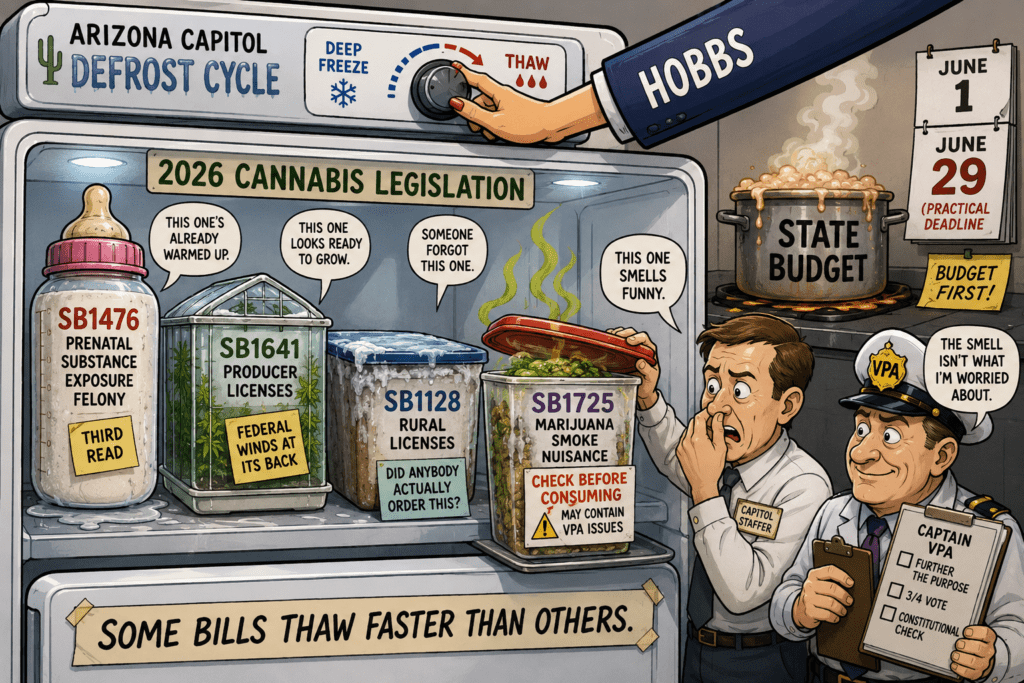
On May 15, Governor Katie Hobbs officially ended her month-long bill signing freeze, creating the first real opportunity in weeks for movement on the four remaining cannabis bills still alive at the Arizona Capitol. While the freeze was intended to force Republican leadership back into budget negotiations, the political standoff effectively trapped dozens of bills in legislative limbo, including several measures with major implications for Arizona’s cannabis industry, patients, consumers, and businesses.
Budget Talks Push Cannabis to the Back Burner
Since April, budget negotiations have dominated nearly every aspect of the legislative session. Hobbs refused to sign bills after talks broke down and later vetoed a Republican-backed budget proposal that she described as partisan and financially irresponsible. Republicans defended the plan as fiscally responsible, but the dispute consumed the Capitol’s attention and pushed most controversial policy issues, including cannabis legislation, to the sidelines.
Cannabis Legislation Stalls
For Arizona’s cannabis bills, the budget fight could not have come at a worse time. As lawmakers focused almost exclusively on spending negotiations, the remaining marijuana-related measures stalled at various stages of the legislative process. While the Legislature never formally adjourned, progress on many policy bills effectively froze as leadership waited for signs that budget negotiations were moving in the right direction.
A Signal That Things Are Moving Again
Hobbs lifting the moratorium is significant because it signals that both sides may finally believe a budget agreement is within reach. It does not mean a deal has been finalized, but it does suggest lawmakers are becoming more confident that negotiations will continue instead of collapsing altogether. That matters because leadership is far more likely to start running floor calendars and advancing legislation if they believe the budget fight is entering its final stages.
The Four Cannabis Bills Still Alive
As lawmakers prepare to return on June 1, attention now shifts to the four remaining cannabis bills awaiting action.
SB1476 currently sits on House Third Read and could move quickly if leadership begins scheduling floor votes again.
SB1725, the marijuana smoke and odor nuisance bill, remains stalled in House Committee of the Whole while concerns surrounding Arizona’s Voter Protection Act continue to raise questions about its legal viability.
SB1641, which would create marijuana producer licenses separate from retail dispensaries, appears to have one of the clearest paths forward and may benefit from the recent federal shift involving medical cannabis.
SB1128, the rural marijuana licensing bill, remains the most politically vulnerable of the group as existing license holders continue to oppose additional market expansion.
The Real Enemy Is the Calendar
The biggest challenge facing all four measures is no longer committee approval or floor votes. It is time.
Arizona’s practical budget deadline is June 29, just one day before the state’s June 30 fiscal deadline. The longer lawmakers spend negotiating the budget, the less floor time remains for controversial policy bills. Leadership is unlikely to dedicate valuable calendar space to divisive cannabis legislation if a state budget remains unresolved.
A Narrow Window Remains
The fate of Arizona’s remaining cannabis bills may depend less on their individual merits and more on how quickly budget negotiators reach an agreement. If lawmakers establish a budget framework early in June, these measures still have a realistic opportunity to move. If negotiations drag into the final weeks of session, cannabis legislation could once again find itself pushed aside as lawmakers race to finish the one thing they absolutely cannot leave unfinished: the state budget.
Escaping Legislative Cryostasis
For now, the Capitol appears to be thawing after weeks of political gridlock. Whether Arizona’s remaining cannabis bills emerge from legislative cryostasis will depend almost entirely on how quickly lawmakers can stop fighting over the budget and return their attention to the rest of the legislative agenda.

At A Glance
SB1476- Prenatal Substance Abuse Felony
Waiting on House Third Read
SB1725- Marijuana Smoking Nuisance
Waiting on House Committee Od Whole
SB1641- Marijuana Producer Licenses
Waiting on House Rules
SB1128- (newly) Marijuana Rural Licenses
Waiting on House Rules
Details
SB1476 Child Neglect; Prenatal Substance Exposure
Waiting on House Third Read
01/29/2026 Senate First Read
01/29/2026 Assigned Senate Judiciary and Elections
02/02/2026 Senate Second Read
02/18/2026 Passed Senate Judiciary and Elections (4-2-1)
02/23/2026 Passed Senate Rules
02/23/2026 Senate Caucus
02/26/2026 Senate(COW) Committee Of Whole
02/26/2026 Passed Senate Third Read (16-14-1)
02/27/2026 Transmit to House
03/09/2026 House First Read
03/09/2026 Assigned House Judiciary Committee
03/10/2026 House Second Read
3/25/2026 Passed House Judiciary Committee (6-2-1)
3/30/2026 Passed House Rules Committee (8-0)
03/31/2026 House Caucus
04/15/2026 Passed House Committee Of Whole (COW)
Makes it a crime of child neglect in Arizona by making it a Class 6 felony for a person who has custody of a child to engage in conduct that harms the child and constitutes neglect as defined in existing law. It also establishes an affirmative defense for the child’s mother if she completed alcohol or drug treatment during pregnancy.
Sections Affected:
13-3619.01 Added
Sponsor:
Bolick Prime
Voter Protection Act Prop 103- No (but might need to be)
Senate Engrossed Version
SB 1641 Marijuana Producers; Licensure
Waiting on House Rules
No Movement
01/30/2026 Introduced Senate
02/05/2026 Senate First Read
02/05/2026 Assigned Senate Regulatory Affairs and Government Efficiency (RAGE)
02/18-2026 Passed Senate Regulatory Affairs and Government Efficiency (RAGE) (vote 8-0-0)
03/11/2026 Due Pass Senate Rules
03/11/2026 Caucus
03/11/2026 Due Pass as Amended Senate (COW) Committee Of Whole
03/11/2026 Passed Senate Third Read (23-5-2)
03/16/2026 House First Read
03/16/2026 Assigned House Commerce Committee
03/17/2026 House Second Read
03/24/2026 Passed House Commerce Committee (7-3)
A marijuana producer is a licensed entity that can cultivate, process, manufacture, package, and store marijuana and marijuana products at a single location, but cannot sell or transfer them directly to consumers. Applications for these licenses will open on January 1, 2029, but until January 1, 2032, only entities with contracts established by January 1, 2026 with a marijuana establishment, nonprofit dispensary, or management company are eligible. During this period, licenses cannot be transferred or subleased, and unlicensed entities are prohibited from cultivating or manufacturing at producer sites. Beginning in 2030, the department will review market conditions annually and may issue additional licenses if it determines consumers would benefit. Marijuana producers are subject only to the same rules as marijuana establishments unless the law specifically provides otherwise.
Sections Affected:
36-2850 Amended
36-2854 Amended
36-2857 Amended
36-2858 Amended
36-2859 Amended
36-2860 Amended
36-2861 Amended
36-2864 Amended
36-2865 Amended
Sponsor:
Payne
VPA- Voter Protection Act (Prop 105): Yes
MORE INFO
SENATE FACT SHEET: 02/16/2026 RAGE
Adopted Amendments Senate
SENATE FACT SHEET: 03/11/2026 RAGE As Passed COW
SB1725: Marijuana Smoke; Public; Private Nuisance
Waiting on House Committee of Whole (COW)
02/04/2026 Senate Introduced
02/05/2026 Senate First Read
02/05/2026 Assigned Senate Judiciary (JUD)
02/20/2026 Passed Senate Senate Judiciary and Elections (JUDE) (vote 5-2-0)
02/25/2026 Passed Senate Rules (5-4-0)
02/25/2026 Senate Caucus
03/03/2026 Due Passed as Amended Senate (COW) Committee Of Whole
03/09/2026 Senate Third Read Passed (20-9-1)
03/16/2026 House First Read
03/16/2026 Assigned House Judiciary Committee
03/17/2026 House Senond Read
3/25/2026 Passed House Judiciary Committee (8-1-0-1)
03/30/2026 Passed House Rules Committee (5-3-0)
03/31/2026 House Caucus
Expands Arizona’s nuisance laws to explicitly treat excessive marijuana smoke and odor as a type of “crime” for purposes of declaring a residential property a nuisance, allowing affected residents, homeowner/property owner associations, and government attorneys to sue to abate the activity, with notice procedures and potential cost liens if an owner who knows about the activity fails to act. The bill also amends the criminal and public nuisance statutes to create presumptions that producing excessive marijuana smoke and odor endangers others’ health/safety (criminal nuisance) and is injurious, offensive, and interferes with property enjoyment (public nuisance)
Sections Affected:
12-991 Amended
13-2908 Amended
13-2917 Amended
Sponsor:
Mesnard
VPA- Voter Protection Act (Prop 105)– NO, but should be
MORE INFO
SENATE FACT SHEET: 02/16/2026 JUDE
SENATE FACT SHEET: 03/03/2026 JUDE As Passed COW
Senate Engrossed Version
SB1128 (now) Marijuana Rural Opportunity Initiative
03/31/2026 Striker Passed House Appropriations Committee (10-7-2)
To establish the Rural Opportunity Initiative (ROI), which authorizes the Arizona Department of Health Services to issue up to 18 marijuana establishment licenses and 18 corresponding nonprofit medical marijuana dispensary registration certificates to create new dual licensees in qualifying unserved rural communities — defined as cities, towns, or census-designated areas with populations under 50,000 that contain parcels located at least 25 miles from an existing marijuana retail location. Applications are accepted electronically April 1–14, 2027, reviewed in time-stamp order, and subject to a structured approval process requiring property ownership documentation, local zoning compliance, background attestations, and good standing with the Corporation Commission. ROI licensees must open within 18 months of license issuance, operate a minimum of 24 hours per week, and may only relocate to another qualifying unserved rural community that has not opted out. Cities, towns, and counties may opt out of the ROI by submitting certified resolutions to the Department at least one month before the application period opens. The legislation also expands existing marijuana establishment licensing rules, including 26 additional licenses under a Social Equity Ownership Program, and mandates that the Department adopt rules by January 1, 2025 to regulate marijuana delivery, with unauthorized delivery subject to a $20,000 civil penalty per violation enforceable by the Attorney General.
Original Sponsor- Gowan
Amendment Sponsor -Livingston
VPA. 3/4 voter requirement- YES
HOUSE – Appropriations – Strike Everything