
Update Weeks 18, 19, 20 & 21
Arizona’s four major cannabis bills are basically sitting in legislative cryostasis until at least June 1 while the Capitol hits pause and the budget war drags on behind closed doors.
Lawmakers recessed without a budget deal after Governor Katie Hobbs vetoed the Republican spending plan, throwing both sides even deeper into a fight over spending and tax conformity. That fight has now spilled into the rest of the legislative session. The Legislature is technically still alive, but most controversial bills are frozen exactly where they sat when lawmakers walked out while leadership and the governor continue negotiations behind the scenes.
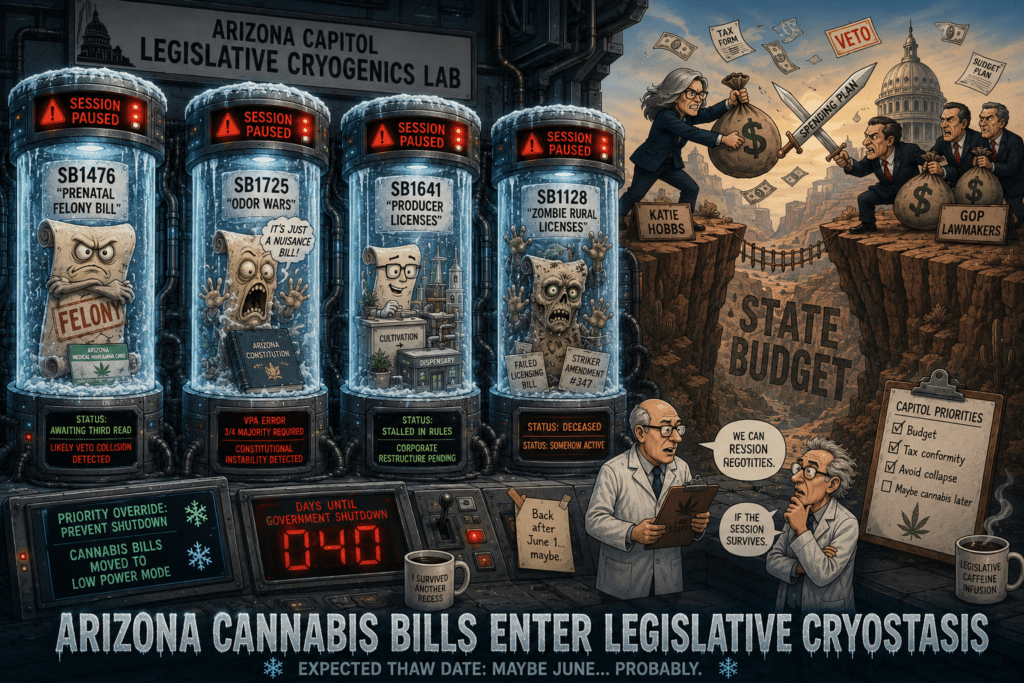
The bigger problem is the clock. Arizona lawmakers still have to finalize a state budget before June 30 to avoid a government shutdown. So even when lawmakers come back June 1, the Capitol is probably heading straight back into budget chaos. Some bills may slowly trickle through committees and floor calendars during June, but leadership’s main focus is going to be preventing a shutdown, not rushing controversial cannabis measures across the finish line.
SB1476 Waits for Final Read
SB1476, the prenatal substance exposure felony bill, already cleared Committee of the Whole weeks ago right as the budget standoff started getting ugly. Since then it has just been sitting on House Third Read waiting for a final vote. The bill likely has enough Republican support to eventually make it to Hobbs’ desk, but that is where the real wall starts. Considering Hobbs’ stance on reproductive freedom and the fact the bill contains no carve out for lawful medical marijuana use, most people around the Capitol expect a veto if it gets that far.
SB1725 and the “Odor Wars”
Then there is SB1725, the marijuana smoke and odor nuisance bill, the measure everybody loves to hate. The bill would make it easier for landlords, HOAs, businesses, and private citizens to file complaints or take legal action over marijuana smoke and odor if they claim it interferes with their property or quality of life. Critics argue the language is broad enough that lawful cannabis users could end up dealing with weaponized odor complaints simply because someone nearby says they smelled marijuana.
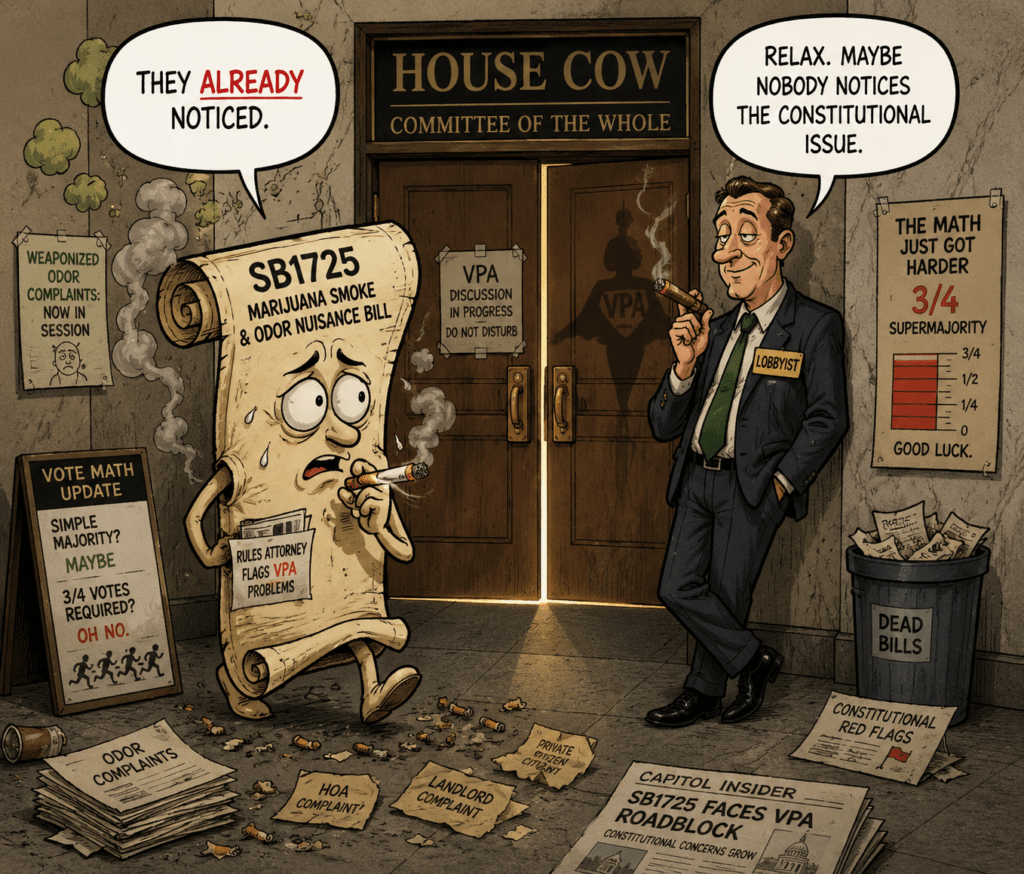
That measure slowed down hard before recess after the House Rules attorney finally pointed out what critics have been saying since the beginning of session: the bill likely has constitutional problems under Arizona’s Voter Protection Act. Because SB1725 restricts conduct tied to Arizona’s voter approved marijuana laws and labels it a nuisance, opponents argue it likely needs a constitutional three fourths supermajority to pass. The bill is now frozen waiting on House Committee of the Whole where lawmakers could eventually try to amend it with VPA language once session resumes. The problem for supporters is that once a three fourths threshold enters the conversation, the math gets much harder very quickly. There are already serious questions about whether the bill even has the votes to survive final read if that happens.
One Bill Has Legs, One Probably Does Not
SB1641, the marijuana producer license bill, also remains stalled in House Rules. The measure would create a new marijuana producer license that separates cultivation and manufacturing operations from retail dispensaries, potentially reshaping how cannabis businesses structure operations in Arizona. Supporters argue it creates more flexibility and business opportunities inside the industry, while critics worry it could expand the market and over saturate it.


Sitting right beside it is SB1128, the rural marijuana zombie bill that came back from the dead through striker language after earlier licensing legislation failed. The measure would expand marijuana licensing opportunities in certain rural areas, reviving a licensing fight many people thought was already politically buried earlier this session. Capitol insiders expect the two measures to keep moving just like they did in the Senate, which likely means the producer licensing bill still has a realistic path forward during the final stretch of session while the rural licensing push probably will not survive once lawmakers start moving bills again.
Leadership Focuses on the Budget Battlefield
But that is the bigger issue hanging over all of this right now. Nobody really knows what leadership plans to prioritize once lawmakers come back June 1 because the budget fight has completely consumed the Capitol. Hobbs already has one of the highest veto counts in the country again this year, Republicans do not want to hand her easy veto targets during negotiations, and leadership seems far more focused on ending the budget war than reigniting controversial cannabis fights.

So for now Arizona’s cannabis agenda is just sitting there. Not dead. Not moving. Just frozen in the middle of a political standoff while everyone waits to see what actually starts moving once lawmakers finally return to the Capitol in June.
At A Glance
SB1476- Prenatal Substance Abuse Felony
Waiting on House Third Read
SB1725- Marijuana Smoking Nuisance
Waiting on House Committee Od Whole
SB1641- Marijuana Producer Licenses
Waiting on House Rules
SB1128- (newly) Marijuana Rural Licenses
Waiting on House Rules
Details
SB1476 Child Neglect; Prenatal Substance Exposure
Waiting on House Third Read
01/29/2026 Senate First Read
01/29/2026 Assigned Senate Judiciary and Elections
02/02/2026 Senate Second Read
02/18/2026 Passed Senate Judiciary and Elections (4-2-1)
02/23/2026 Passed Senate Rules
02/23/2026 Senate Caucus
02/26/2026 Senate(COW) Committee Of Whole
02/26/2026 Passed Senate Third Read (16-14-1)
02/27/2026 Transmit to House
03/09/2026 House First Read
03/09/2026 Assigned House Judiciary Committee
03/10/2026 House Second Read
3/25/2026 Passed House Judiciary Committee (6-2-1)
3/30/2026 Passed House Rules Committee (8-0)
03/31/2026 House Caucus
04/15/2026 Passed House Committee Of Whole (COW)
Makes it a crime of child neglect in Arizona by making it a Class 6 felony for a person who has custody of a child to engage in conduct that harms the child and constitutes neglect as defined in existing law. It also establishes an affirmative defense for the child’s mother if she completed alcohol or drug treatment during pregnancy.
Sections Affected:
13-3619.01 Added
Sponsor:
Bolick Prime
Voter Protection Act Prop 103- No (but might need to be)
Senate Engrossed Version
SB 1641 Marijuana Producers; Licensure
Waiting on House Rules
No Movement
01/30/2026 Introduced Senate
02/05/2026 Senate First Read
02/05/2026 Assigned Senate Regulatory Affairs and Government Efficiency (RAGE)
02/18-2026 Passed Senate Regulatory Affairs and Government Efficiency (RAGE) (vote 8-0-0)
03/11/2026 Due Pass Senate Rules
03/11/2026 Caucus
03/11/2026 Due Pass as Amended Senate (COW) Committee Of Whole
03/11/2026 Passed Senate Third Read (23-5-2)
03/16/2026 House First Read
03/16/2026 Assigned House Commerce Committee
03/17/2026 House Second Read
03/24/2026 Passed House Commerce Committee (7-3)
A marijuana producer is a licensed entity that can cultivate, process, manufacture, package, and store marijuana and marijuana products at a single location, but cannot sell or transfer them directly to consumers. Applications for these licenses will open on January 1, 2029, but until January 1, 2032, only entities with contracts established by January 1, 2026 with a marijuana establishment, nonprofit dispensary, or management company are eligible. During this period, licenses cannot be transferred or subleased, and unlicensed entities are prohibited from cultivating or manufacturing at producer sites. Beginning in 2030, the department will review market conditions annually and may issue additional licenses if it determines consumers would benefit. Marijuana producers are subject only to the same rules as marijuana establishments unless the law specifically provides otherwise.
Sections Affected:
36-2850 Amended
36-2854 Amended
36-2857 Amended
36-2858 Amended
36-2859 Amended
36-2860 Amended
36-2861 Amended
36-2864 Amended
36-2865 Amended
Sponsor:
Payne
VPA- Voter Protection Act (Prop 105): Yes
MORE INFO
SENATE FACT SHEET: 02/16/2026 RAGE
Adopted Amendments Senate
SENATE FACT SHEET: 03/11/2026 RAGE As Passed COW
SB1725: Marijuana Smoke; Public; Private Nuisance
Waiting on House Committee of Whole (COW)
02/04/2026 Senate Introduced
02/05/2026 Senate First Read
02/05/2026 Assigned Senate Judiciary (JUD)
02/20/2026 Passed Senate Senate Judiciary and Elections (JUDE) (vote 5-2-0)
02/25/2026 Passed Senate Rules (5-4-0)
02/25/2026 Senate Caucus
03/03/2026 Due Passed as Amended Senate (COW) Committee Of Whole
03/09/2026 Senate Third Read Passed (20-9-1)
03/16/2026 House First Read
03/16/2026 Assigned House Judiciary Committee
03/17/2026 House Senond Read
3/25/2026 Passed House Judiciary Committee (8-1-0-1)
03/30/2026 Passed House Rules Committee (5-3-0)
03/31/2026 House Caucus
Expands Arizona’s nuisance laws to explicitly treat excessive marijuana smoke and odor as a type of “crime” for purposes of declaring a residential property a nuisance, allowing affected residents, homeowner/property owner associations, and government attorneys to sue to abate the activity, with notice procedures and potential cost liens if an owner who knows about the activity fails to act. The bill also amends the criminal and public nuisance statutes to create presumptions that producing excessive marijuana smoke and odor endangers others’ health/safety (criminal nuisance) and is injurious, offensive, and interferes with property enjoyment (public nuisance)
Sections Affected:
12-991 Amended
13-2908 Amended
13-2917 Amended
Sponsor:
Mesnard
VPA- Voter Protection Act (Prop 105)– NO, but should be
MORE INFO
SENATE FACT SHEET: 02/16/2026 JUDE
SENATE FACT SHEET: 03/03/2026 JUDE As Passed COW
Senate Engrossed Version
SB1128 (now) Marijuana Rural Opportunity Initiative
03/31/2026 Striker Passed House Appropriations Committee (10-7-2)
To establish the Rural Opportunity Initiative (ROI), which authorizes the Arizona Department of Health Services to issue up to 18 marijuana establishment licenses and 18 corresponding nonprofit medical marijuana dispensary registration certificates to create new dual licensees in qualifying unserved rural communities — defined as cities, towns, or census-designated areas with populations under 50,000 that contain parcels located at least 25 miles from an existing marijuana retail location. Applications are accepted electronically April 1–14, 2027, reviewed in time-stamp order, and subject to a structured approval process requiring property ownership documentation, local zoning compliance, background attestations, and good standing with the Corporation Commission. ROI licensees must open within 18 months of license issuance, operate a minimum of 24 hours per week, and may only relocate to another qualifying unserved rural community that has not opted out. Cities, towns, and counties may opt out of the ROI by submitting certified resolutions to the Department at least one month before the application period opens. The legislation also expands existing marijuana establishment licensing rules, including 26 additional licenses under a Social Equity Ownership Program, and mandates that the Department adopt rules by January 1, 2025 to regulate marijuana delivery, with unauthorized delivery subject to a $20,000 civil penalty per violation enforceable by the Attorney General.
Original Sponsor- Gowan
Amendment Sponsor -Livingston
VPA. 3/4 voter requirement- YES
HOUSE – Appropriations – Strike Everything