
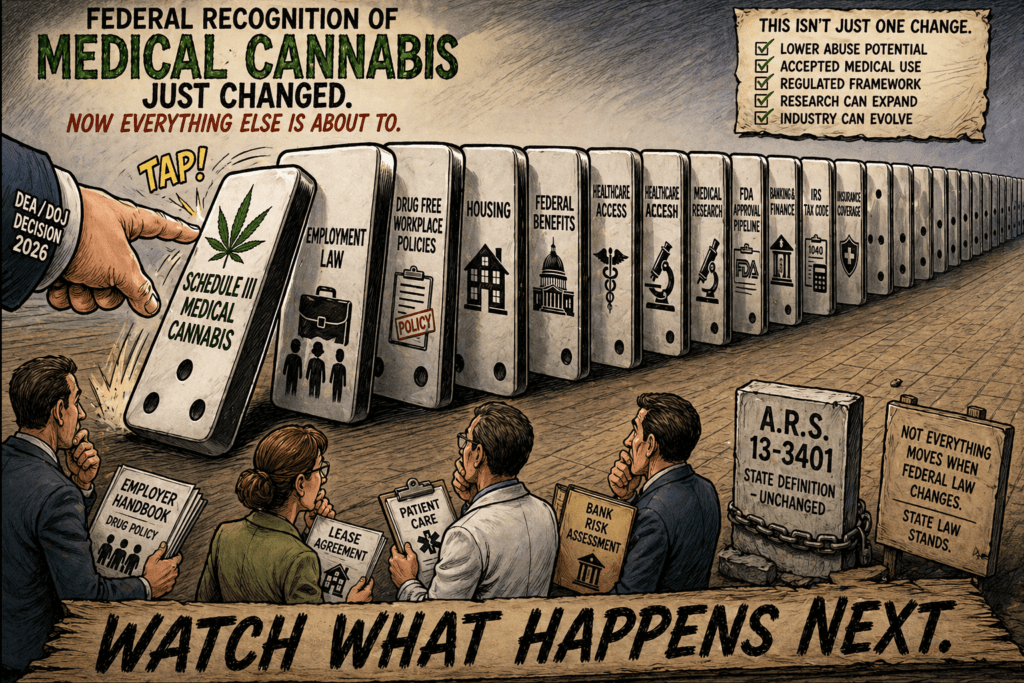
On April 22, 2026, the federal government finally moved on cannabis, but not in the way people think. This is not legalization. This is not a green light for recreational use. This is a controlled, narrow shift that pulls medical cannabis into a federally recognized system while everything else stays exactly where it was.
Here is what actually happened.
The federal government moved medical cannabis into Schedule III, but only under specific conditions. This applies to FDA approved cannabis drugs and cannabis operating inside state licensed medical programs. That is it. Everything outside of that lane still sits in Schedule I. Recreational cannabis did not move. That hearing is set to start June 29th 2026, Black market cannabis did not move. Synthetic THC did not move. Hemp stays exactly where it is. If it is not medical and regulated, nothing changed.

What did change is the structure around medical cannabis. For the first time, the federal government is building a system that allows state licensed operators to step into federal compliance. Dispensaries, cultivators, and manufacturers can now apply for DEA registration. And the government is not starting from scratch.
If You Live in a State With No Program
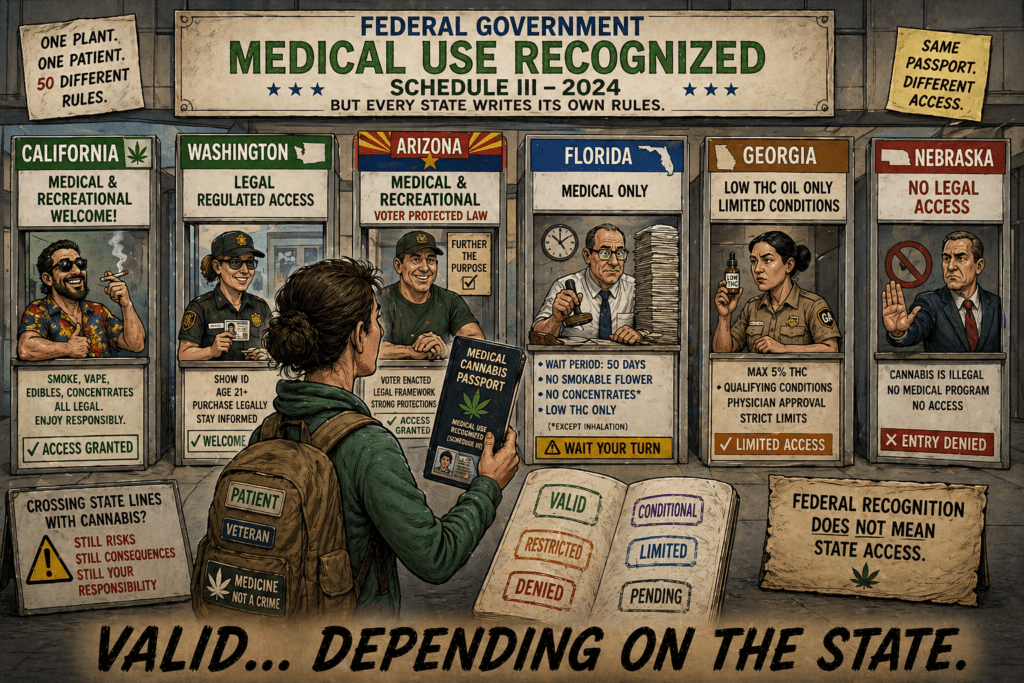
You still do not get access. Federal recognition does not override state bans. States control their own criminal laws. Until state legislatures move, cannabis stays illegal in those jurisdictions. This order adds pressure. It does not force change. I can not vacation in Nebraska with my medical marijuana and expect not to do jail time.
If You Are a Patient
This is the first time the federal government aligns with what patients have said for years. Cannabis is medicine. But your day to day life does not suddenly change. You still get your card through the state. You still buy from licensed dispensaries. Your protections still come from state law. Patients already face minimal risk of federal arrest, especially in states like Arizona where compliance systems are strong and visible. Federal enforcement has not focused on individual patients in any meaningful way for years. This order does not dramatically change that reality. It formalizes it. It puts legal language behind what has already been happening in practice.
Move To Schedule III and Arizona State Law
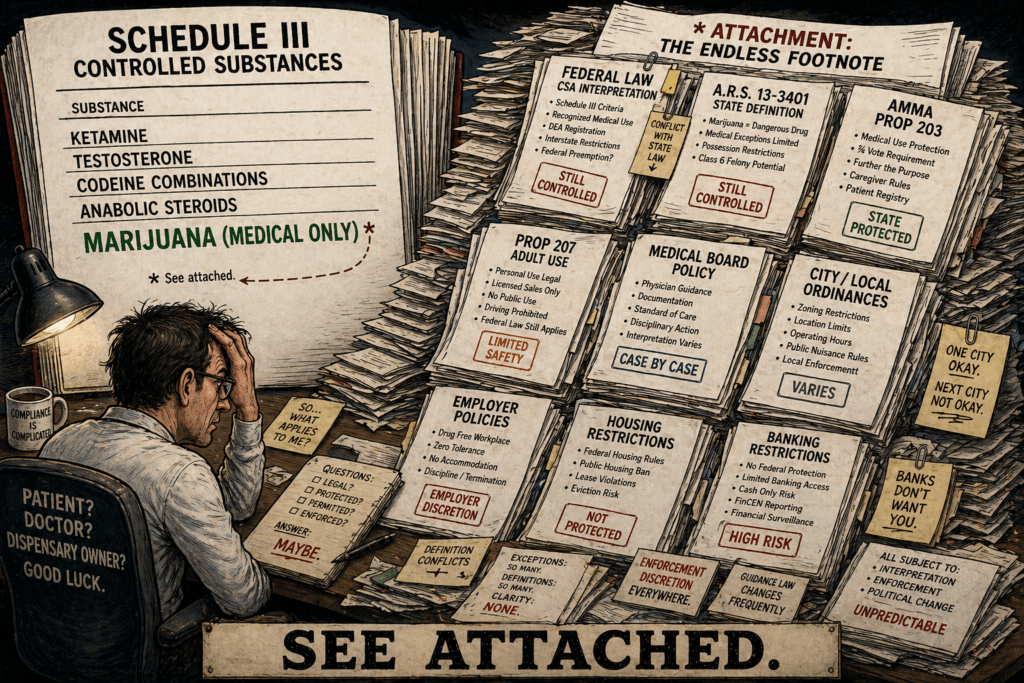
Where this becomes complex is how it interacts with existing Arizona law. Some statutes directly reference the federal Controlled Substances Act. If those statutes rely on federal scheduling to define what is illegal or restricted, a shift to Schedule III for medical cannabis could change how those laws apply. Definitions could evolve without the state legislature taking action.
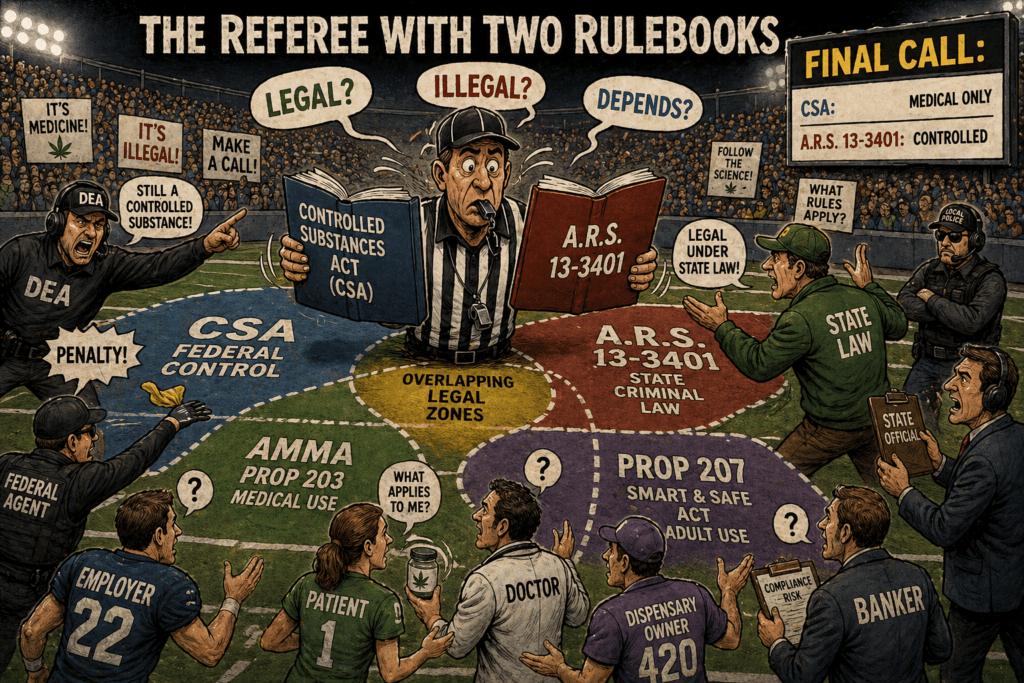

But many Arizona laws reference A.R.S. 13 3401, which is the state’s own definition of controlled substances. That definition does not automatically change when federal scheduling changes. So now you have two parallel systems. One that moves with federal law and one that stays fixed under state law. That split will create legal gray areas, especially in employment, housing, and regulatory enforcement.
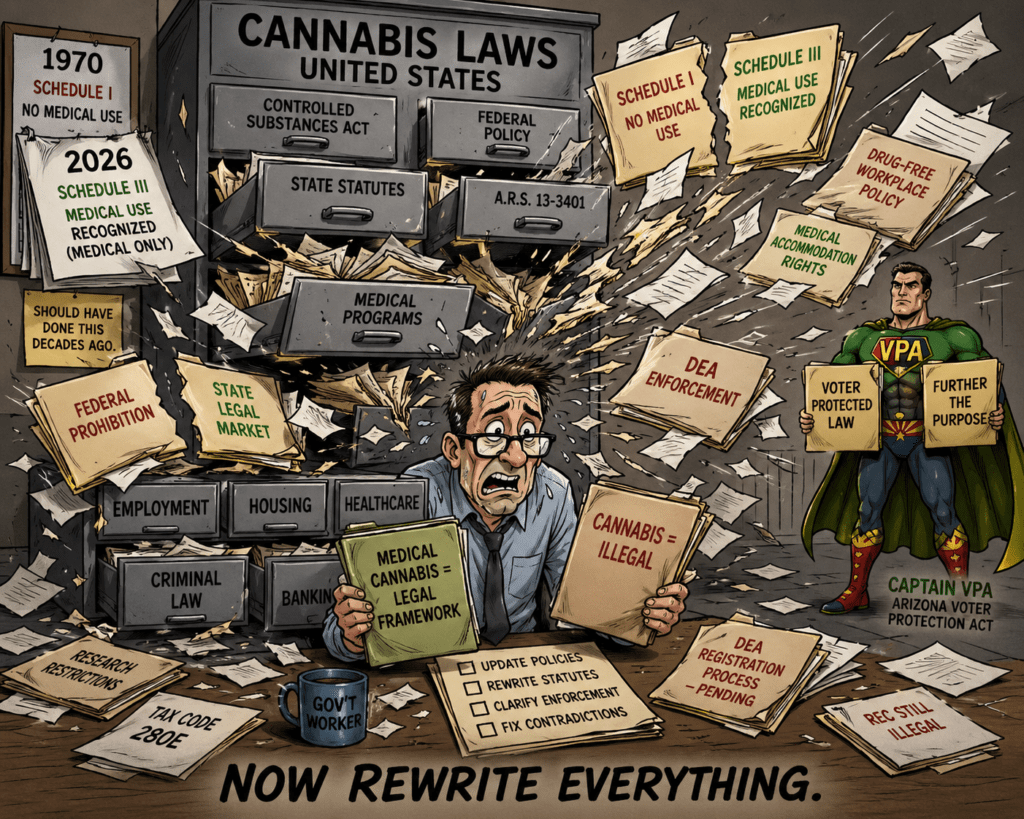
This is why the full effects will take time to surface. This is not a single law changing. It is a web of laws, policies, and systems that all reference cannabis in different ways. Every one of those references has to be reevaluated. Employers will have to reconsider drug policies. Housing authorities will have to interpret eligibility rules. Medical boards will have to adjust guidance for doctors. Courts will have to interpret how these changes apply in real cases. And laws with need to be written to align the two.
Where The Change Really Is Noticed
Universities can pursue research with fewer restrictions. Pharmaceutical companies can develop cannabis based medications within a recognized framework. Doctors can begin to operate in a system that the federal government acknowledges instead of one it ignores. And maybe just maybe doctors can start becoming educated about the endocannabinoid system.
The Real Shift Happens On The Business Side
The real shift hits on the business side. For medical cannabis dispensaries, this is where the ground actually moves. Medical Marijuana in Schedule III under the Controlled Substances Act, creates something the industry has never had before: a legitimate pathway into the federal system through DEA registration.
That changes the entire posture of a business. A DEA-registered operation doesn’t exist in the gray anymore. It operates inside a federally recognized framework. It follows federal compliance rules, tracks inventory at a level that meets federal standards, and maintains records that can stand up under real oversight. Cannabis businesses have spent years building state-level compliance systems. This takes it to a completely different level.
Taxes and Banking
Then comes the financial shift. For medical operators, this move cuts directly into Internal Revenue Code Section 280E. Right now, that rule forces cannabis businesses to pay taxes on an inflated version of income because they can’t deduct normal expenses. Schedule III breaks that cycle for qualifying medical operations.
Now they can write off rent. Payroll. Utilities. Security. Marketing. The basic costs of running a business. That alone changes survival math. Margins stop bleeding at the federal level. Businesses finally operate like actual businesses instead of surviving under a tax penalty.
From there, everything starts to open. Banks that avoided cannabis because of federal risk now have a clearer lane to work with DEA-registered medical operators. Access to loans, credit lines, and standard financial services becomes realistic instead of theoretical.
More Questioins
But this is where reality complicates everything. In Arizona and most legal states, medical and recreational licenses are tied together. The same dispensary often runs both sides of the business under one roof. Now you have a situation where one part of that business could qualify for federal recognition while the other part remains federally illegal.

That creates a structural conflict that the industry has never had to deal with. Dispensaries may need to split operations, create separate entities, or physically separate inventory and sales systems. They may have to decide whether pursuing DEA registration for the medical side is worth the cost and oversight when it could complicate or even conflict with their recreational operations.
New Global Import/ Export Compliance
There are also new rules around how cannabis moves across national borders, and this is where things stop being just a U.S. policy shift and start becoming a global compliance issue. Import and export now require federal permits. That is not a random add-on. That is the United States staying in line with international law under the Single Convention on Narcotic Drugs.
That treaty sets the rules. It requires countries to tightly control cannabis and limit it to medical and scientific use. It also requires governments to track production, monitor supply, and account for where it goes. Once the U.S. decided to recognize medical cannabis at the federal level, it had to adjust the system to stay compliant with those obligations. That is why every shipment of medical cannabis crossing a international border now requires a permit. The federal government needs to know who is sending it, who is receiving it, how much is moving, and what it is being used for. There is no free-flow cannabis trade at the international level. Every movement gets tracked.
This also connects to the bigger structure behind the scenes. The United States has to estimate how much cannabis it needs for medical and scientific use, report actual numbers, and prevent overproduction. That is why you see quotas, reporting requirements, and federal oversight tied into this rule. It is not about convenience. It is about control and documentation.
If the U.S. skipped this step and allowed open cannabis imports or exports, it would break treaty obligations. That creates international pressure and legal conflicts that go far beyond domestic policy. So instead, the government threads the needle. It recognizes medical cannabis, builds a regulated system around it, and locks down how it moves across borders.
Prohibition Went International
The international treaty system the United States must comply with did not appear overnight. The United States did not just build cannabis policy at home. It helped build the global rulebook too. That makes things a little tricky for recreational cannabis moving forward.
It started in 1912 with the International Opium Convention. That agreement focused on opium, morphine, and cocaine. Cannabis was barely on the radar at that point. Then things shifted. In 1925, cannabis got pulled into international controls through updates to those agreements. That move set the stage for what came next.
The real turning point came with the Single Convention on Narcotic Drugs. That treaty built the system we still live under today. Countries agreed to limit drugs, including cannabis, to medical and scientific use only. They agreed to control production, track distribution, and lock down international trade. This was not a suggestion. It was a coordinated global framework.
That is why the new federal rules around cannabis movement look the way they do. The United States is not acting in a vacuum. Once it recognizes medical cannabis at the federal level, it has to plug that recognition into the global system it helped create.
Meanwhile in America: It Didn’t Start With Science, It Started With Fear
Cannabis prohibition in the United States did not start with doctors or research. It started with local politics.
Look at El Paso in 1914. During the Mexican Revolution, migration increased into border towns. Local officials and media tied cannabis to crime and violence. That narrative spread fast and stuck. Policy followed perception. No federal guidance. No medical consensus. Just fear turning into law. That matters because it set the tone for everything that came after.
The Federal Government Didn’t Ban It, It Trapped It
Then the federal government stepped in with the Marihuana Tax Act of 1937. On paper, it did not ban cannabis. In reality, it made legal participation impossible. If you wanted to handle cannabis, you had to register with the federal government and pay a tax on every transaction using official stamps. That sounds simple until you hit the catch. The government did not issue the stamps. You needed something you could not get. That turned every transaction into a crime.
That design was intentional. At the time, the federal government did not have clear authority to outright ban substances, so it used tax law as the workaround. A major force behind this push was Harry Anslinger. He drove aggressive anti-cannabis messaging using sensational crime stories and propaganda like Reefer Madness. That campaign reshaped public perception and gave political cover to lock cannabis down nationwide.
That is how cannabis became functionally illegal across the country. And once that framework took hold, it did not disappear. It evolved.
1970 Is Where Everything Locks In
Then came the Controlled Substances Act. This is the moment that still controls everything today. Cannabis landed in Schedule I, the most restrictive category. That classification says no accepted medical use and a high potential for abuse. Here is the part most people never hear. That classification was supposed to be temporary. The Shafer Commission studied cannabis and recommended decriminalization and a lower-risk classification. The government ignored it.
Why keep it in Schedule I?
Because it became tied to the War on Drugs under Richard Nixon. Keeping cannabis in the strictest category gave the federal government maximum enforcement power and fit the political strategy of that era. That single decision set off a chain reaction. It blocked research. It created harsh penalties. It triggered IRS 280E, which still punishes cannabis businesses financially. It created the split we still live with today between state legalization and federal prohibition.
Bare Minimum At Its Best
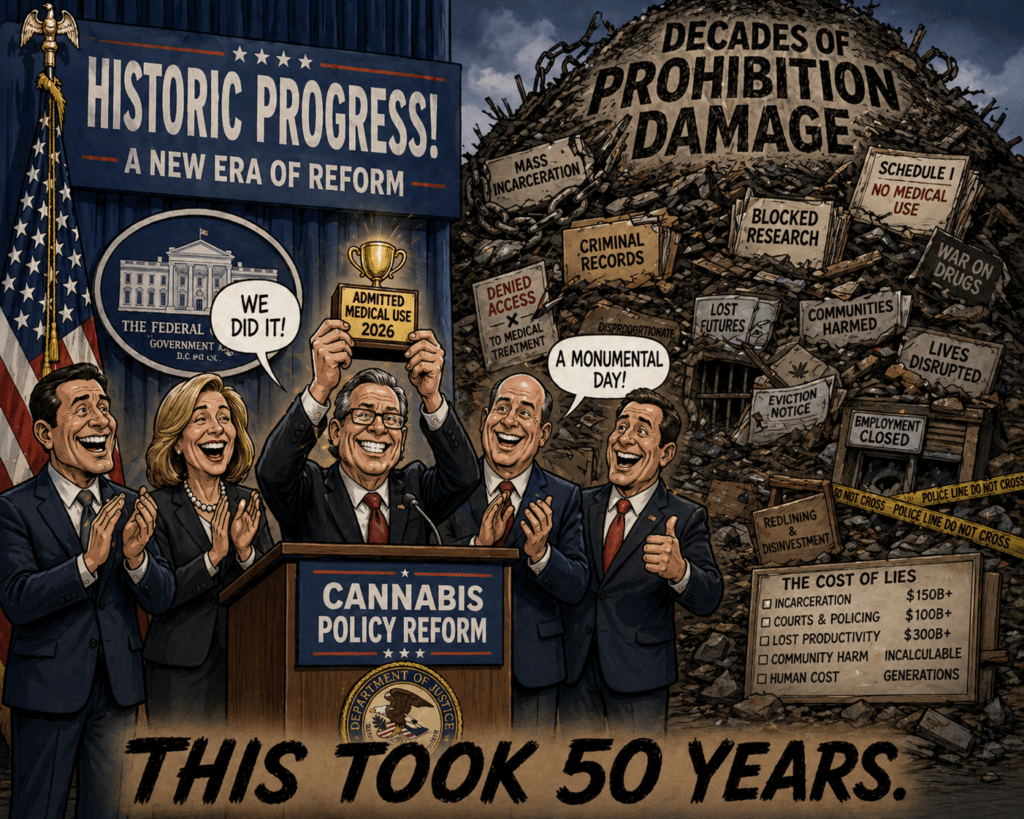
At the end of the day, this is the bare minimum. The federal government finally admitted cannabis has medical value. That should have happened decades ago. It corrects a false premise that shaped law and policy for generations, but it does not undo the damage that premise caused.
Recreational users still sit outside the system. People with past convictions still carry those consequences. Businesses still operate in a split legal reality. And patients gain recognition.