

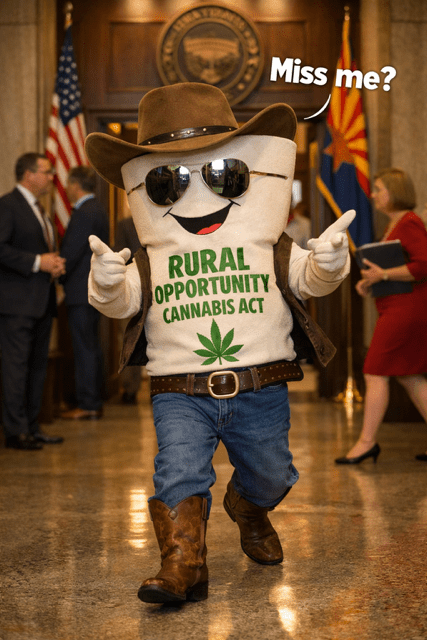
Arizona lawmakers came out swinging during the first week of the session, introducing five cannabis-related bills. Week two told a very different story. Only one marijuana bill appeared and it brought a familiar name and an even stranger concept back into the conversation.
The Rural Opportunity Initiative Makes a Comeback
Sen. David Gowan, a Republican from Legislative District 19, reintroduced the Rural Opportunity Initiative, a bill that aims to push the cannabis industry into smaller, underserved communities across the state. The proposal would create 18 new “dual-license” permits, allowing dispensaries to sell both medical and recreational marijuana in rural areas that currently have no access. To qualify, a business would need to set up shop in a town with fewer than 50,000 residents and stay at least 25 miles away from the nearest existing dispensary. The bill targets communities that sit far outside Arizona’s current cannabis map.
The Arizona Department of Health Services would award licenses to the first qualified applicants who submit electronic applications. Each application would receive a timestamp. If two applicants hit “submit” in the same second, the state would settle the tie with a random drawing turning the licensing process into a literal game of chance. Cities and counties would keep control under the bill. Local governments could opt out of the program entirely by passing a formal resolution before the state issues a license in their area.
Once approved, dispensary owners would need to open within 18 months and keep their business running at least 24 hours per week. The rules aim to prevent companies from sitting on licenses without serving the community.
What’s Coming Next?
The seven-bill deadline has already passed, but that doesn’t mean cannabis legislation has finished rolling out. If history holds, those measures may drop a wave of marijuana-related proposals in the coming weeks. Stay tuned—this session may still have a few surprise strains left to unveil.
DETAILS
HB2081-Medical Marijuana; Terminal Illness (Ryan’s Law)
Pre filed Intro
01/12/2026 House First Read
01/13/2026 Second Read
01/13/2026 Assigned House Health and Human Services Committee
The proposal, titled Ryan’s Law, would update Arizona’s medical marijuana statute by clarifying definitions and expanding protections for qualifying patients, particularly those with terminal illnesses. The measure would maintain existing possession and cultivation limits for patients and caregivers, refine eligibility standards for caregivers and dispensary agents, and reaffirm restrictions related to prior violent or serious felony convictions. It would also require licensed health care facilities to allow terminally ill patients to use medical marijuana in designated areas, prohibit smoking or vaping, include marijuana use in medical records, and permit reasonable storage and safety restrictions, unless compliance would jeopardize federal funding or licensing. Other facilities could still adopt reasonable limits on use, but could not unreasonably deny access. The changes would take effect only with approval by a three‑fourths vote of each chamber of the Legislature.
Sections Affected:
36-2801 Amended
36-2805 Amended
Sponsor: Bliss
VPA- Voter Protection Act (Prop 105): Yes
MORE INFO
HB 2632: Landlords; Tenant’s Marijuana Use
01/15/2026 Introduced House
1/20/2026 House First Read
1/21/2026 House Second Read
1/20/2026 Assigned House Commerce Committee
The measure would prohibit landlords from terminating a rental agreement solely because a tenant uses marijuana.
Sections Affected:
33-1317.01 Added
Sponsor:
Austin Prime
Garcia Co-Sponsor
Sandoval Co-Sponsor
Villegas Co-Sponsor
VPA- Voter Protection Act (Prop 105): Yes
MORE INFO
HB2801: Marijuana Convictions; Misdemeanors; Fines; Assessments
01/15/2026 Introduced House
01/20/2026 House First Read
01/20.2026 Assigned House Judiciary Committee
01/21/2026 House Second Read
The legislation would expand and clarify Arizona’s marijuana expungement law, allowing individuals with certain low‑level marijuana offenses committed before November 30, 2020, to petition courts to erase their criminal records. Eligible offenses include limited possession, small‑scale home cultivation, and marijuana paraphernalia. Courts would notify prosecutors, hold hearings if needed, and grant expungement unless prosecutors prove ineligibility. Approved petitions would vacate convictions, seal records, restore civil rights, and prevent expunged offenses from being used in future prosecutions, with the measure taking effect only if three‑fourths of lawmakers in each chamber approve it.
Sections Affected:
36-2862 Amended
Sponsor:
Volk
VPA- Voter Protection Act (Prop 105): Yes
MORE INFO
HCR2029: Marijuana; Unincorporated Areas; Reservations; Prohibition
No Movement
01/15/2026 Introduced House
HCR 2029 would send a measure to Arizona voters that bars the state from issuing medical or adult‑use marijuana licenses in unincorporated areas completely surrounded by Indian reservations. The proposal would prohibit nonprofit medical marijuana dispensaries, marijuana establishments, and marijuana testing facilities from operating in these locations, effectively limiting cannabis businesses in so‑called “county islands” encircled by tribal land, with voters deciding the issue at the next general election.
Sponsor:
Peshlakai Prime
Austin Co-Sponsor
Cavero Co-Sponsor
Connolly Co-Sponsor
Liguori Co-Sponsor
Márquez Co-Sponsor
Sandoval Co-Sponsor
Villegas Co-Sponsor
VPA- Voter Protection Act (Prop 105): No (goes to ballot)
MORE INFO
HCR2037 Marijuana; Conviction Exclusion; Cultivation
(The Arizona Marijuana Alignment and Public Safety Act)
No Movement
01/15/2026 Introduced House
The Arizona Marijuana Alignment and Public Safety Act would update state marijuana law by tightening licensing requirements, regulating cultivation, and preparing for potential federal changes. The proposal would bar individuals with violent crime convictions from owning or controlling marijuana businesses and require regulators to deny or revoke licenses for violations. It would set a standard cultivation canopy of 15,000 square feet per license, allow approved shared canopy agreements, and establish enforceable limits on residual solvents in marijuana products. The measure would prohibit interstate marijuana commerce unless federal law allows it, require a seed‑to‑sale tracking system to prevent diversion, and authorize license suspension or revocation for violations. It would also direct the state to develop a framework for voluntary participation in any future federal marijuana registration system and allow information sharing with federal agencies, with the proposal ultimately going before voters at the next general election.
Sections Affected:
36-2870 Added
36-2871 Added
36-2872 Added
36-2873 Added
36-2874 Added
Sponsor:
Rivero Prime
VPA- Voter Protection Act (Prop 105): No (goes to ballot)
MORE INFO
SB1363: Marijuana; Rural Opportunity Initiative
01/22/2026 Introduced House
This legislation authorizes 18 new dual-license marijuana permits for communities with fewer than 50,000 residents that sit at least 25 miles from the nearest existing dispensary. The Department of Health Services will grant these licenses to the first qualified applicants who submit timestamped electronic filings, using a random drawing only to break a tie. Although the bill expands the market, it preserves local authority by allowing cities and counties to opt out of the program through a formal resolution. Once they secure a license, business owners must launch their retail sites within 18 months and maintain at least 24 hours of operation per week.
Sections Affected
36-2803.01 Amended
36-2854 Amended
36-2857.01 Added
Sponsor:
Gowan Prime
VPA- Voter Protection Act (Prop 105): Yes
MORE INFO