

We now return to our regularly scheduled updates.
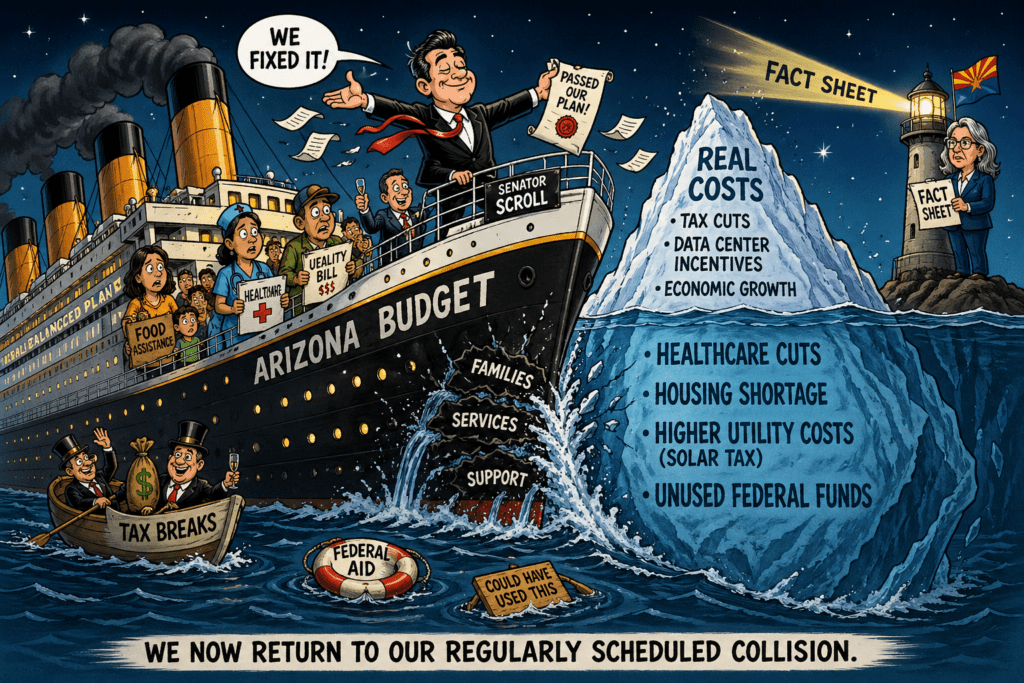
Although the Republican-led state legislature passed its budget on the House side, the future of the freeze now rests with the Senate. Even if it passes there, we still need to consider that Governor Hobbs issued a fact sheet on Friday, with her office arguing the Republican-led proposal shifts money upward while raising costs on everyday Arizonans.
The plan includes hundreds of millions in tax breaks, including incentives for industries like data centers, while cutting or scaling back funding for healthcare, food assistance, and housing. According to the fact sheet, that could mean fewer people covered, less support for families, and reduced affordable housing, all while new taxes on solar and clean energy drive up utility costs. Federal dollars tied to food programs may also go unused, adding another layer of concern. Based on the tone of the fact sheet, it sounds unlikely she will sign the proposed budget, which means the freeze will likely continue.
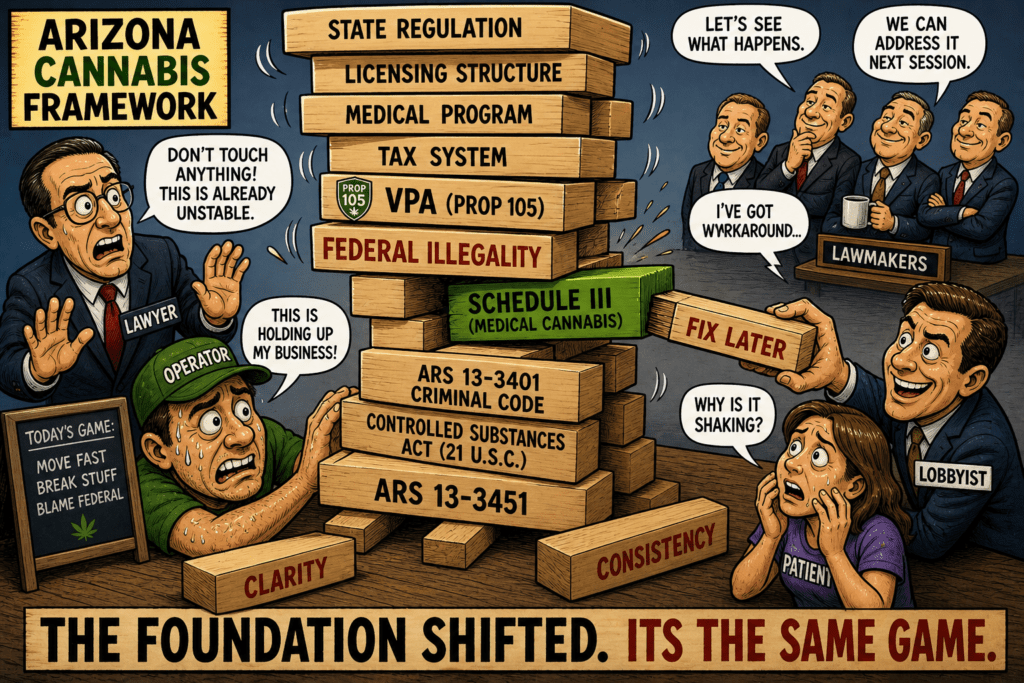
Since no measures have moved again, the focus shifts to what is changing around them. Medical marijuana moving into Schedule III territory means the federal government now recognizes it as having accepted medical use. That does not legalize everything, but it changes the baseline these bills were written under.
SB1725: Built on an Old Assumption
SB1725 was built on a legal assumption that no longer holds the same weight. Lawmakers have long relied on the idea that cannabis, while legal in Arizona, remained illegal federally. That gave them room to regulate use through restrictions like nuisance laws. With medical cannabis now recognized as having accepted medical use at the federal level, that foundation has shifted. The bill still treats odor and smoke as presumed harm, but that assumption becomes harder to justify when the substance is now recognized as part of a medical framework.


As covered in prior articles, the constitutional issue starts with Arizona’s voter-approved protections. Proposition 207 and Proposition 203 define what lawful cannabis use looks like, and the Voter Protection Act limits how far the Legislature can go in changing that framework.
SB 1725 runs into that wall. Any change that effectively alters those voter-approved laws should require a three-fourths vote and must further the original purpose. This measure was flagged for that three-fourths requirement. The bill does not directly rewrite the statutes, but it tries to restrict how they operate in practice by labeling otherwise lawful use as a nuisance. That puts it in the same gray area Arizona has dealt with before. It is an indirect attempt to narrow voter-approved rights, now made more complicated by the federal shift.
Although the VPA is still the strongest argument, there is also growing tension with disability law. The line used to be clearer when cannabis was federally illegal. That made it easier to dismiss protections tied to its use.
Now that medical cannabis sits in a recognized category of treatment, that line is less defined. SB 1725 does distinguish between medical and adult use when applying nuisance standards, but only by allowing a court to treat a valid registry identification card as a mitigating factor. In simple terms, a mitigating factor is something that can lessen how serious the situation is or reduce a penalty, but it does not stop someone from being found at fault in the first place.
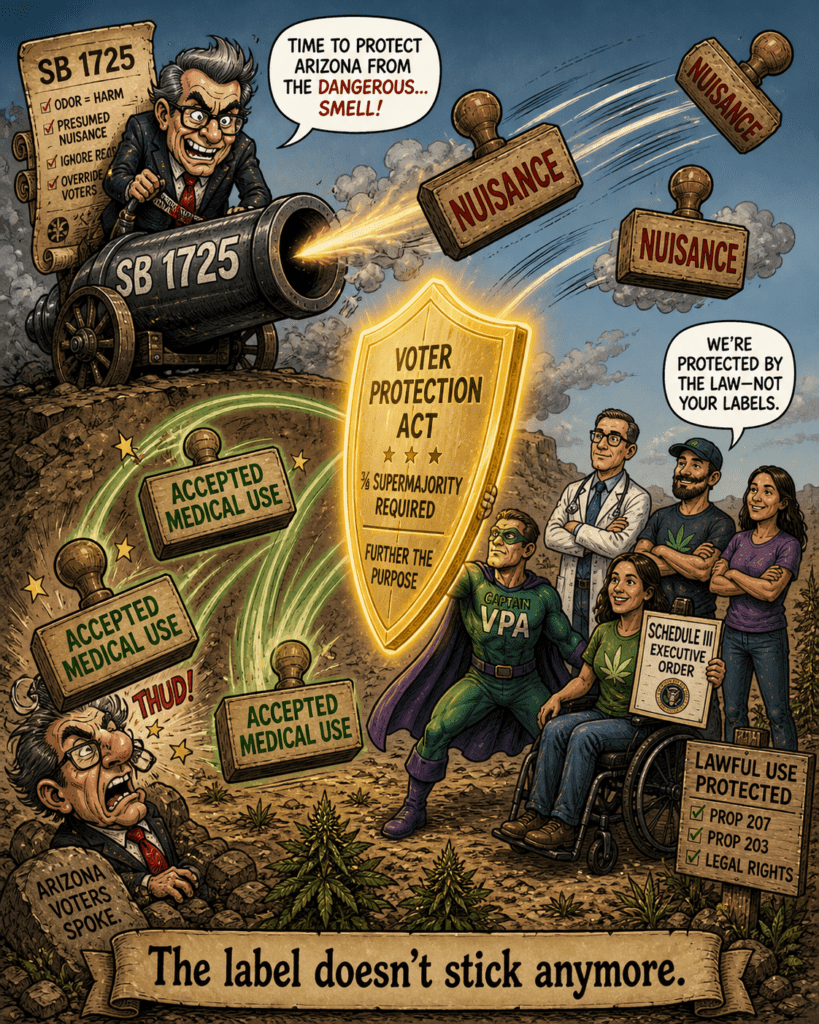
That leaves the issue unresolved. The bill does not clearly protect patients, but it does not clearly ignore their status either. Instead, it puts the decision in the hands of courts after the fact. As medical cannabis continues to gain legal recognition, that gray area is likely to become harder to defend, not easier.
SB1476: Medical Use Meets Criminal Risk
SB 1476 opens the door to felony child neglect charges based on prenatal substance exposure. It does not separate illegal drug use from cannabis that is legal under Arizona law or recognized for medical use. That is where the problem begins.
A patient could be following state law, using cannabis with a doctor’s recommendation, and using something now recognized at the federal level as medicine, and still face criminal risk under this bill. That is because SB 1476 relies on Arizona’s criminal definition of controlled substances in A.R.S. 13-3401, not the federal Controlled Substances Act. The result is a legal mismatch. What counts as lawful medical use in one system can still trigger criminal consequences in another. The line is no longer clear.
This also runs into existing case law. In Ridgell v. Arizona Department of Child Safety, the court pushed back on treating prenatal cannabis exposure alone as neglect when the use is lawful. With cannabis now recognized as medical at the federal level, that argument only gets stronger. SB1476 moves in the other direction by attaching criminal penalties to the same space, which sets up a direct legal collision.
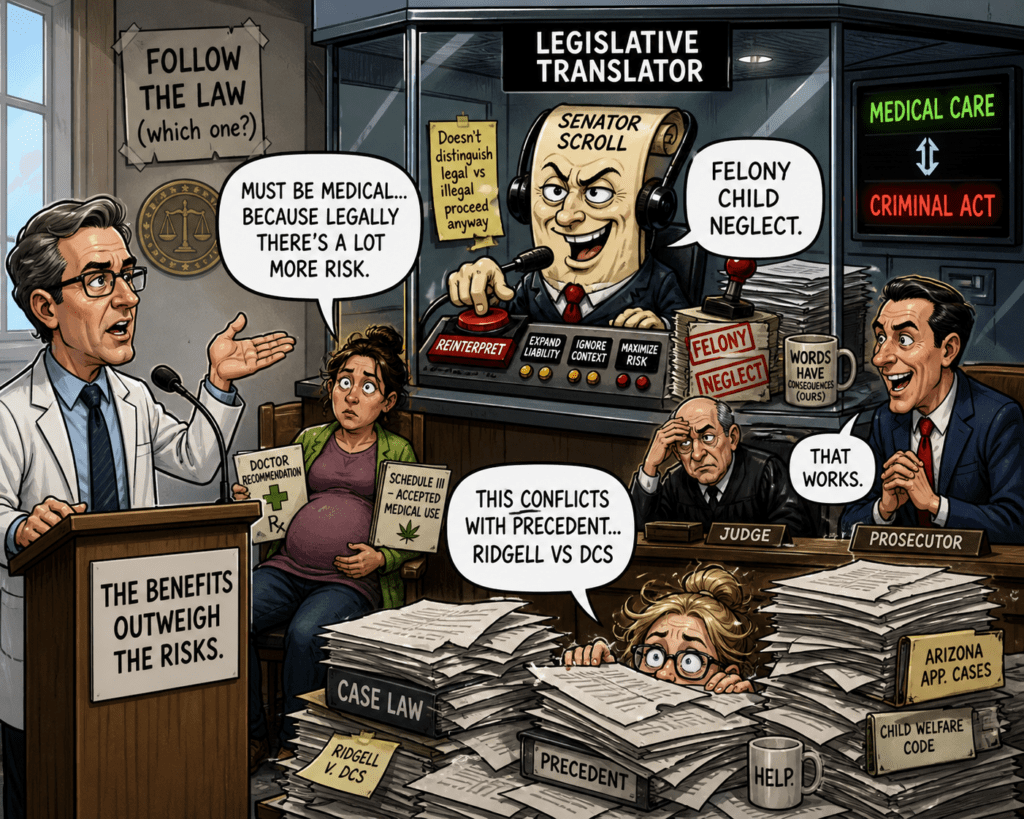
Nothing about the bill itself has changed, but the legal environment around it has. Schedule III complicates how this law would be applied, strengthens arguments that medical cannabis use falls under legitimate care, and raises new questions about how far the state can go in turning those outcomes into criminal charges.
SB1641: Structuring a Split Market
SB1641 was written as a structural change to Arizona’s cannabis market. It creates a new “producer” license that separates cultivation and manufacturing from retail sales. On its own, that looks like a technical shift away from the vertically integrated system voters approved. But with medical cannabis now recognized at the federal level as a Schedule III substance, the meaning of that separation starts to change.

Medical and adult use no longer sit in the same legal space. One can move toward federal compliance. The other remains federally illegal. SB1641 starts to build a system that can handle that split. When everything sat under the same federal prohibition, there was no reason to separate. Now there is. SB1641 does not say it directly, but it starts laying the groundwork for a split market. Medical and adult use are drifting into different regulatory lanes, with infrastructure already in place to support it.
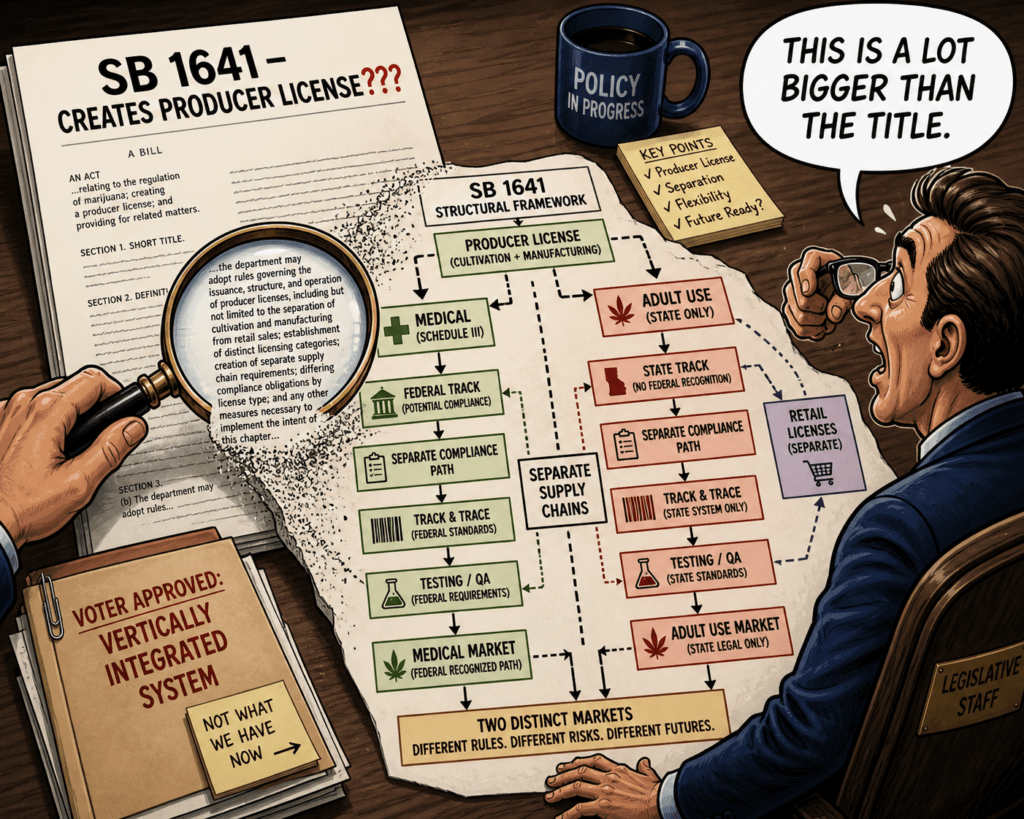
So while nothing has moved at the Capitol, the pressure around this bill has. SB1641 no longer reads as just a license expansion. It reads as early positioning, a system preparing for a future where medical cannabis operates under a different set of rules than adult use, and where operators have to decide which side of that line they want to be on.
SB1128: Expansion Without Adjustment
SB1128 was written as an access bill. It expands cannabis into rural Arizona, adds new licenses, and pushes the same dual-use model the state has relied on for years: one operator, one location, medical and recreational under the same roof. That structure made sense when everything sat in the same federal category. It does not hold the same way now.
Medical cannabis has moved into a federally recognized space. Adult use has not. That creates a split the bill never accounts for. New rural operators would be dropped into a system where one side of their business could eventually qualify for federal compliance while the other side remains federally illegal. There is no requirement in the bill to separate operations, no pathway to split inventory or licensing, and no framework for choosing one lane over the other. What used to be a single market is now two systems pulling in different directions.
That shift also changes what “access” means. This is no longer just about getting dispensaries closer to rural communities. It starts to overlap with medical access, patient protections, and how the state treats cannabis as part of healthcare. SB1128 does not prioritize medical supply or build in protections tied to that shift. It treats medical and recreational cannabis as interchangeable, even as federal law draws a clearer line between them.
At the same time, this split could create opportunity for operators willing to adapt. If medical cannabis moves toward a federally compliant system, businesses may need to separate their medical and recreational sides entirely. That opens the door for new models. Rural license holders, brands operating through partnerships, and smaller operators could choose to align strictly with medical production and distribution if they want access to banking, tax relief, or federal recognition. But SB1128 does not build that pathway. It keeps everything bundled together.
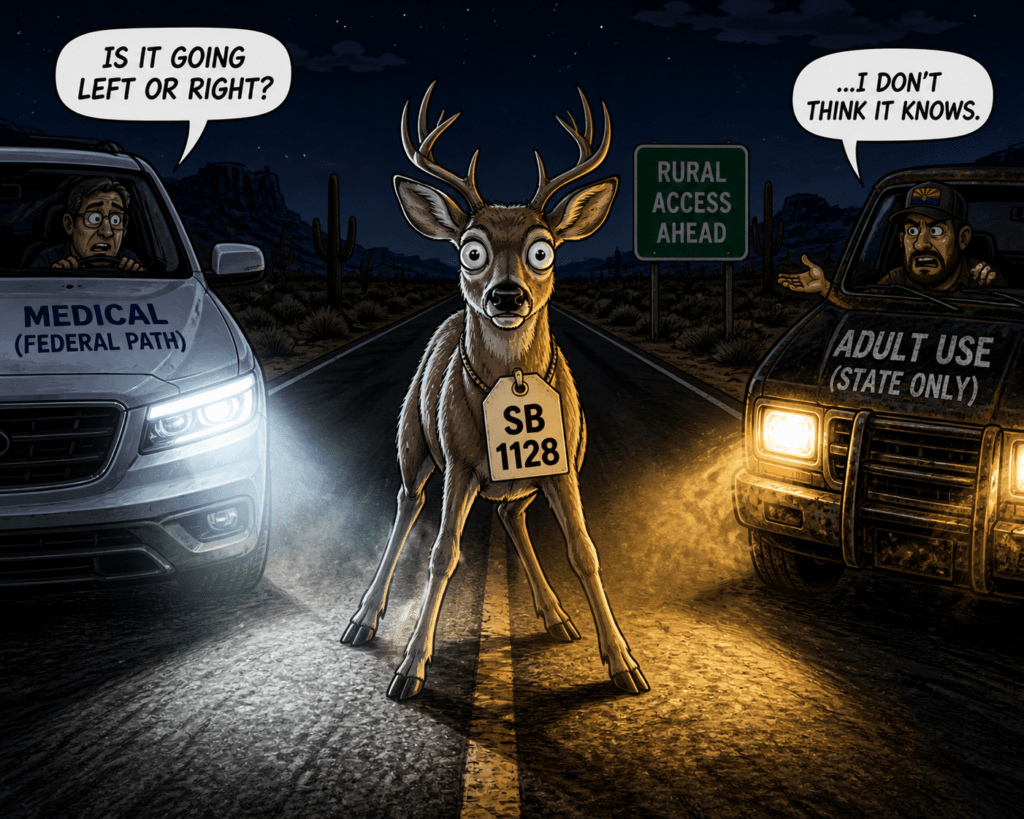
That leaves the bill sitting in a familiar place. It expands the system geographically without updating the structure underneath it. So while nothing has moved at the Capitol, the environment around SB1128 has. It no longer reads as a simple rural expansion bill. It reads as a policy built for a single system being applied to a market that is starting to split. The longer that gap exists, the harder it becomes for new operators to figure out which system they are actually stepping into.
The Bigger Picture

As lawyers, lobbyists, activists, patients, operators, and cannabis law enthusiasts dig deeper, everyone is learning in real time. Every new rule, every agency memo, and every federal detail changes the conversation a little more. Arizona is not just watching bills sit on a calendar anymore. It is watching old cannabis policy collide with a new legal reality. The state built its market around one framework. Now that infrastructure has a crack in it. The question is whether lawmakers fix the foundation before operators and patients are forced to figure it out the hard way.

At A Glance
SB1476- Prenatal Substance Abuse Felony
Waiting on House Third Read
SB1725- Marijuana Smoking Nuisance
Waiting on House Committee Od Whole
SB1641- Marijuana Producer Licenses
Waiting on House Rules
SB1128- (newly) Marijuana Rural Licenses
Waiting on House Rules
Details
SB1476 Child Neglect; Prenatal Substance Exposure
Waiting on House Third Read
01/29/2026 Senate First Read
01/29/2026 Assigned Senate Judiciary and Elections
02/02/2026 Senate Second Read
02/18/2026 Passed Senate Judiciary and Elections (4-2-1)
02/23/2026 Passed Senate Rules
02/23/2026 Senate Caucus
02/26/2026 Senate(COW) Committee Of Whole
02/26/2026 Passed Senate Third Read (16-14-1)
02/27/2026 Transmit to House
03/09/2026 House First Read
03/09/2026 Assigned House Judiciary Committee
03/10/2026 House Second Read
3/25/2026 Passed House Judiciary Committee (6-2-1)
3/30/2026 Passed House Rules Committee (8-0)
03/31/2026 House Caucus
04/15/2026 Passed House Committee Of Whole (COW)
Makes it a crime of child neglect in Arizona by making it a Class 6 felony for a person who has custody of a child to engage in conduct that harms the child and constitutes neglect as defined in existing law. It also establishes an affirmative defense for the child’s mother if she completed alcohol or drug treatment during pregnancy.
Sections Affected:
13-3619.01 Added
Sponsor:
Bolick Prime
Voter Protection Act Prop 103- No (but might need to be)
Senate Engrossed Version
SB 1641 Marijuana Producers; Licensure
Waiting on House Rules
No Movement
01/30/2026 Introduced Senate
02/05/2026 Senate First Read
02/05/2026 Assigned Senate Regulatory Affairs and Government Efficiency (RAGE)
02/18-2026 Passed Senate Regulatory Affairs and Government Efficiency (RAGE) (vote 8-0-0)
03/11/2026 Due Pass Senate Rules
03/11/2026 Caucus
03/11/2026 Due Pass as Amended Senate (COW) Committee Of Whole
03/11/2026 Passed Senate Third Read (23-5-2)
03/16/2026 House First Read
03/16/2026 Assigned House Commerce Committee
03/17/2026 House Second Read
03/24/2026 Passed House Commerce Committee (7-3)
A marijuana producer is a licensed entity that can cultivate, process, manufacture, package, and store marijuana and marijuana products at a single location, but cannot sell or transfer them directly to consumers. Applications for these licenses will open on January 1, 2029, but until January 1, 2032, only entities with contracts established by January 1, 2026 with a marijuana establishment, nonprofit dispensary, or management company are eligible. During this period, licenses cannot be transferred or subleased, and unlicensed entities are prohibited from cultivating or manufacturing at producer sites. Beginning in 2030, the department will review market conditions annually and may issue additional licenses if it determines consumers would benefit. Marijuana producers are subject only to the same rules as marijuana establishments unless the law specifically provides otherwise.
Sections Affected:
36-2850 Amended
36-2854 Amended
36-2857 Amended
36-2858 Amended
36-2859 Amended
36-2860 Amended
36-2861 Amended
36-2864 Amended
36-2865 Amended
Sponsor:
Payne
VPA- Voter Protection Act (Prop 105): Yes
MORE INFO
SENATE FACT SHEET: 02/16/2026 RAGE
Adopted Amendments Senate
SENATE FACT SHEET: 03/11/2026 RAGE As Passed COW
SB1725: Marijuana Smoke; Public; Private Nuisance
Waiting on House Committee of Whole (COW)
02/04/2026 Senate Introduced
02/05/2026 Senate First Read
02/05/2026 Assigned Senate Judiciary (JUD)
02/20/2026 Passed Senate Senate Judiciary and Elections (JUDE) (vote 5-2-0)
02/25/2026 Passed Senate Rules (5-4-0)
02/25/2026 Senate Caucus
03/03/2026 Due Passed as Amended Senate (COW) Committee Of Whole
03/09/2026 Senate Third Read Passed (20-9-1)
03/16/2026 House First Read
03/16/2026 Assigned House Judiciary Committee
03/17/2026 House Senond Read
3/25/2026 Passed House Judiciary Committee (8-1-0-1)
03/30/2026 Passed House Rules Committee (5-3-0)
03/31/2026 House Caucus
Expands Arizona’s nuisance laws to explicitly treat excessive marijuana smoke and odor as a type of “crime” for purposes of declaring a residential property a nuisance, allowing affected residents, homeowner/property owner associations, and government attorneys to sue to abate the activity, with notice procedures and potential cost liens if an owner who knows about the activity fails to act. The bill also amends the criminal and public nuisance statutes to create presumptions that producing excessive marijuana smoke and odor endangers others’ health/safety (criminal nuisance) and is injurious, offensive, and interferes with property enjoyment (public nuisance)
Sections Affected:
12-991 Amended
13-2908 Amended
13-2917 Amended
Sponsor:
Mesnard
VPA- Voter Protection Act (Prop 105)– NO, but should be
MORE INFO
SENATE FACT SHEET: 02/16/2026 JUDE
SENATE FACT SHEET: 03/03/2026 JUDE As Passed COW
Senate Engrossed Version
SB1128 (now) Marijuana Rural Opportunity Initiative
03/31/2026 Striker Passed House Appropriations Committee (10-7-2)
To establish the Rural Opportunity Initiative (ROI), which authorizes the Arizona Department of Health Services to issue up to 18 marijuana establishment licenses and 18 corresponding nonprofit medical marijuana dispensary registration certificates to create new dual licensees in qualifying unserved rural communities — defined as cities, towns, or census-designated areas with populations under 50,000 that contain parcels located at least 25 miles from an existing marijuana retail location. Applications are accepted electronically April 1–14, 2027, reviewed in time-stamp order, and subject to a structured approval process requiring property ownership documentation, local zoning compliance, background attestations, and good standing with the Corporation Commission. ROI licensees must open within 18 months of license issuance, operate a minimum of 24 hours per week, and may only relocate to another qualifying unserved rural community that has not opted out. Cities, towns, and counties may opt out of the ROI by submitting certified resolutions to the Department at least one month before the application period opens. The legislation also expands existing marijuana establishment licensing rules, including 26 additional licenses under a Social Equity Ownership Program, and mandates that the Department adopt rules by January 1, 2025 to regulate marijuana delivery, with unauthorized delivery subject to a $20,000 civil penalty per violation enforceable by the Attorney General.
Original Sponsor- Gowan
Amendment Sponsor -Livingston
VPA. 3/4 voter requirement- YES
HOUSE – Appropriations – Strike Everything